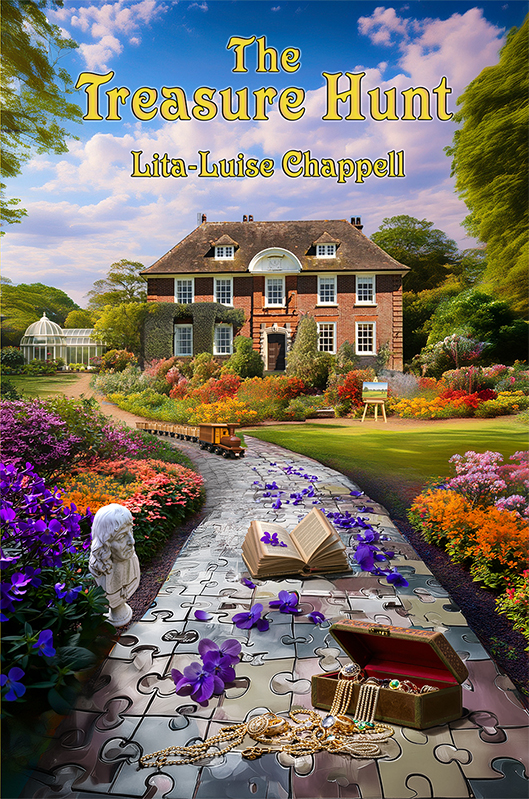
The Treasure Hunt
In the first book of the Puzzler Series, Detective Chief Inspector Alfred Flavian Bowman of London’s Criminal Investigation Division applies his knowledge and intuition to solve unusual crimes. Critically injured just short of his retirement, he takes up doing jigsaw puzzles, which help him see the clues of a crime like pieces in a puzzle, thus earning the nickname “the puzzler.” His housekeeper, Ulima, her son Jason, and Jason’s wife Gia, enjoy acting as his eyes, ears, and legs on volunteer missions to assist him. Together with Detective Inspector Chester Hughes, they work to solve unusual crimes.
Grayson Carter inherited his wealth from the success of his grandfather’s early locomotive designs. When Grayson and his brother Conrad were children, their grandmother, Amelia Carter, taught them the Treasure Hunt Game to keep them entertained while their parents were busy socialites. She hid treasures in her garden for the boys to find. After their mother passed away, their father married a young uneducated woman named Molly. Soon, items in the house begin to disappear. Grayson joins forces with his chauffeur, Kasper, to search for the missing items. Meanwhile, a series of thefts occur in London, and oddly, flower petals are left behind at the scene of the crimes, challenging Alfred and Chester. Who is behind the thefts, what do the flowers mean, and how do they lead to one of London’s vast underground economies? Chester and Alfred dub the case “The Treasure Hunt.”
Available in Paperback and Kindle formats:
Published 2026 by Templar Media | 344 pages | ISBN-13: 979-8986984872
EXCERPT:
“Some people like to see how fast they can put a puzzle together. That’s where puzzles and crimes differ. Working fast to complete a puzzle defeats the whole reason for doing one. Like police who jump to the wrong conclusion trying to quickly find a guilty party. Puzzles are meant to be a pastime. Solving a puzzle is not a race. If a person rushes a puzzle, they only become frustrated. If the police rush too quickly to solve a case, then they might ignore a clue, misunderstand a motive, and too often accuse the wrong person. Both the rapid puzzler, and the police who are working to solve a mystery, must subdue their egos.
“There’s more. All puzzle pieces have hooks and knobs, or as some people call them, ‘outies’ and ‘innies.’ Sometimes when I have a particularly large part of a puzzle that is the same color, I sort by the hooks and knobs. I make a row of one knob and three hooks, then opposing knobs and opposing hooks, then two knobs followed by two hooks, followed by three knobs and one hook, and last, a row of those that have four knobs and no hooks. That way, if I have a space surrounded by other pieces of the same color, I need only to look for the piece that has the right knobs and hooks.
“There are always motives to a crime. The knobs are the reasons why someone would act a certain way. You’ll notice that every piece has at least one knob. That means that everyone in a crime can have a motive for their actions, no matter what they say or claim. Only by looking at the circumstances surrounding them will I be able to tell if that motive is a contributing factor, or if a person is lying. Each new clue that I discover is like adding another piece to the picture of the crime. That’s why I enjoy puzzles. They help me to understand and eventually see what the entire mystery is. The more pieces that fit, the closer I get to solving the mystery.”
 The official website of Lita-Luise Chappell, writer on sex, magic, food, distant lands, and everyday life with articles, poetry, novels, travelogues, rituals, cookbooks, and short-stories.