Monday, May 19
We had another early breakfast at 8:00, so we could drive the distance and get to our booked reservation at Lascaux IV at 9:50 a.m. This complete recreated site of the original Lascaux cave is a must see if one is in the area. In fact, it is the most popular site for prehistoric art open to over 100,000 people every year. The cave is located in the Montignac-Lascaux commune in the Vézère Valley. It is one of the most important decorated caves of the Upper Paleolithic, with its delineated paintings and engravings, especially of animals. Most prehistorians date it to the Early Magdalenian period, around 21,000 BCE.
The cave was discovered in 1940 and opened to the public in 1948. The original cave had to be closed in 1963, due to the green algae, white mold, and black fungi that had accumulated on the paintings, from the number of humans who had viewed it. That is why only very few specialists are the only ones allowed in, and why a reproduction had to be created. The original cave is located in the hillside above Lascaux IV. The name comes from the original family that owned the land.
The discovery goes back to when a dog and three boys found the small opening. A tree in a storm had blown over and the roots exposed an entrance. When the boys entered and saw the paintings, they brought their teacher, the paintings were authenticated, and then it soon opened to others.
The building that houses this reproduction is immense, housing not only the cave but other places the visitor can enter to learn about the cave.
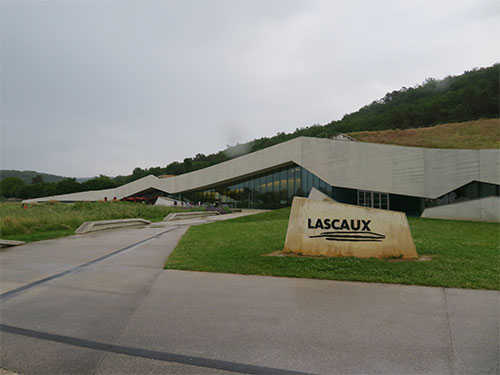
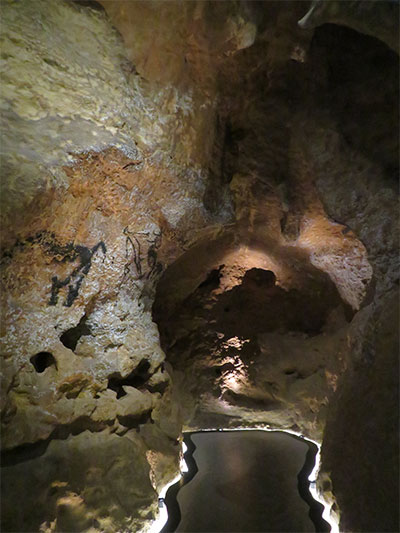
We were met by a guide who led us with an English narrative. We would not be able to take any pictures within, but would be able to at the end, where a room had recreated certain aspects. The cave was presented in a linear succession of galleries. The first room was the Hall of the Bulls or Rotunda, almost 56 feet long, 20 feet wide, and 23 feet high. This is the most spectacular of all the compositions. The gallery is full of aurochs, a dozen horses, six small deer, and a bear.
It continues with the Axial Diverticulum, which is an area that bulges outward from the wall. It is decorated with cattle and horses, deer, and an ibex. From the Hall of the Bulls, to the right, we walked along the Passage, a gallery of around fifteen meters. The décor there was severely damaged by air, so it was nearly bare. In the extension of the Passage, it opened to the Nave, a corridor about twenty meters higher. The Nave continued with an undecorated section, where the walls were not suitable to draw on. Beyond that, there were four groups of figures: a footprint panel, a black cow panel, five swimming deer with large antlers, and one with bison drawings. They were accompanied by geometric symbols that have never been interpreted.
Then there was another bulging area that was along a narrow corridor of about sixty-five feet, of large cats. They appeared to be urinating to mark their territory. There was also a horse, unusually seen from the front. The Apse was a round room, opening toward the west at the junction between the Passage and the Nave. The gallery contained over a thousand engravings, most superimposed on other paintings, and it contained the only reindeer depicted in the cave. The Well opened at the bottom of the Apse. Access to it required a descent of approximately 4 to 5 meters to the start of the lower network. We did not have access, but could look down into it. The drawings within (reproduced in a display room at the end), showed a semi-reclining man with an erect penis, the head of a bird, and with only three fingers. On the left was a rhinoceros and a horse. A sandstone lamp was found nearby. It is thought that this may have a mythological meaning.
Aside from the lamp, other items were found; such as flint tools, painter’s brushes, engraving sticks, spear points, flint blades, bone needles, tallow lamps, and paint colors of yellow, red and black. Since all the coloration were of mineral, and not organic, it was impossible through radio-carbon dating, to get an accurate date. Perhaps the most unusual aspect to all the paintings, is that there were no flowers, plants, trees, landscapes, or human figures, aside from the partial humanoid found in the well.
There is no evidence of humans having lived in the cave. No blackened walls or ceilings indicating internal fires. A small amount of charcoal was dated from 22,000 to 17,000 BCE. Only artists, talented in their way of depiction, were given free-reign to draw. Were the galleries a way of telling a story? Were they an instruction on what the animals were outside? Only one animal is struck with arrows, so most drawings were not an instruction on how to kill it. Were the depictions a sanctuary for the learned? Were the drawings used for some kind of initiatory process? Or were the animals simply a reproduction of what the artist had seen? We may never know.
There are other Lascaux reproductions of the original cave. Lascaux I was a photographic reproduction. Lascaux II was a representation reproduced of only the first gallery. Lascaux III was a partial reproduction designed to travel to other countries. And Lascaux IV, where we were, which depicted the most from the original cave, was opened in December of 2016.
After our guided tour, we entered an exhibition hall, where we could look more closely at the reproductions of the most important painted features and animals. Our headsets automatically continued to describe what we were looking at.
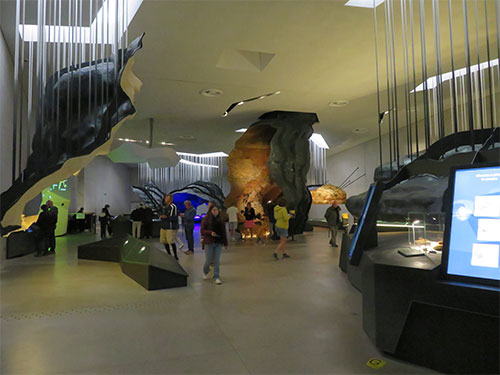
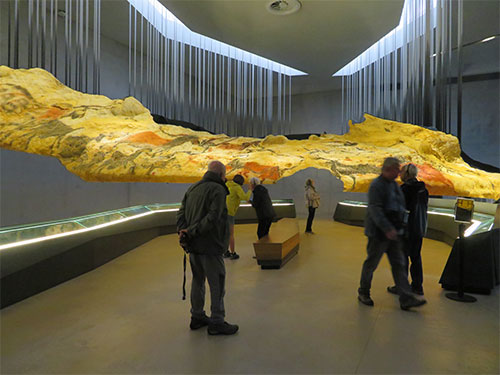
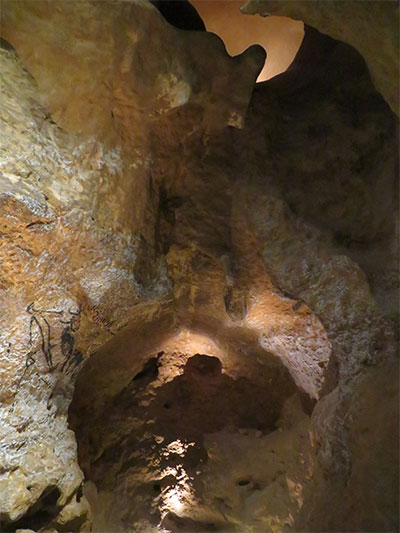
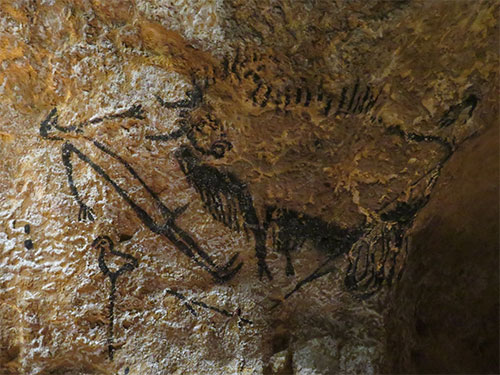
Then we crossed the hall and sat for a film presenting painted art from around the world, showing that humans have been expressing themselves in similar ways in many places. Then the next room showed images of the animals from different parts of the world, scanned across the walls and floor, indicating other cave art and where they were found. Some of the images were made to move, jump and run. A small boy watching, ran around the room trying to catch the creatures. It was fun to watch him so excited to touch the wall where they stood and moved.
That was about it for the exhibits, so we entered the gift shop, bought magnets, a book on the site, and a cookbook of Southwest French specialties. We saw that it was still raining through the large windows facing the front, and chose to have a sandwich lunch at their café.
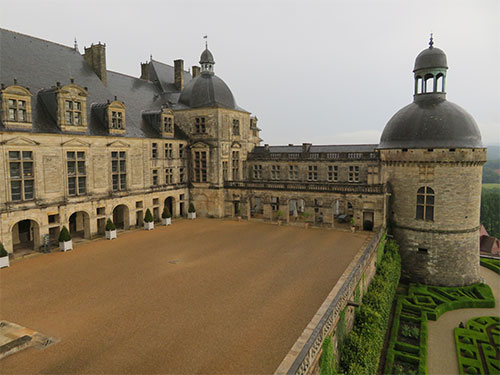
Thirty-five minutes to the north, we arrived at our next site, at Chateau de Hautefort, that is, a castle that was (haut=high and fort=strong) upon the land. Its history dates to 987 C.E., where a feudal fortress stood, in the commune of Hautefort. It also has a Templar heritage. One of the first people to own the castle was Guy de Lastours, a descendent of Gouffier, one of the first thirty knights to enter Jerusalem in 1099. He went with Godfrey de Bouillon, who recaptured the Holy city of Jerusalem in 1099, and became its ruler.
The story of the chateau continues when it was passed to the House of Born through marriage, to Bertran de Born, the troubadour of kings and a warrior, who took back his mother’s name of Lastours. He is also the man who gave Eleanor of Aquitaine a large sum of money, needed to pay for her son’s release, King Richard the Lionheart, who had been imprisoned by Duke Leopold of Austria.
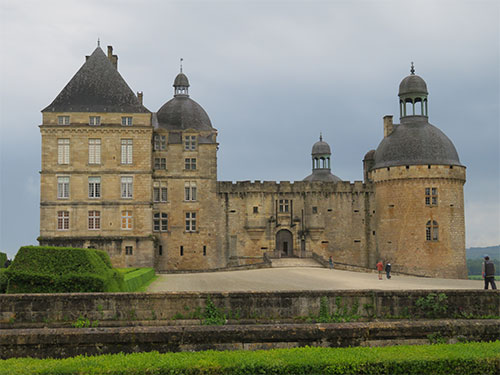
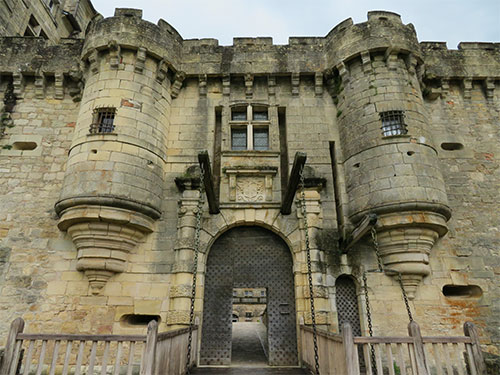
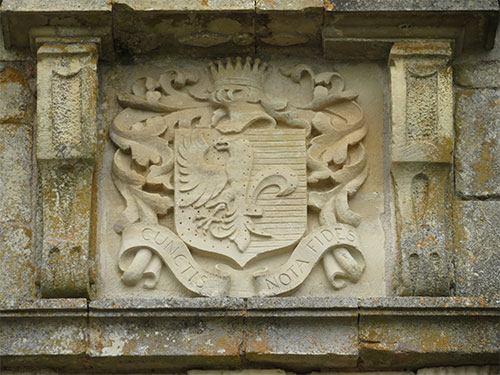
The family of Born, reclaimed the heritage with a marriage, and they became the Viscounts of Hautefort. During the Hundred Years’ War, the English occupied the castle until a ransom was also paid on the castle, to get it back. Perhaps because of its payments coming in align with the ruler, their castle was spared during the French Revolution. Through it all, the castle has been kept through the female line with Marie de Hautefort, who was most known for her beauty and virtuous works. The castle is also known, for a brief time during the eleven-month Reign of Terror (1793-1794), when it held more than 150 men as prisoners.
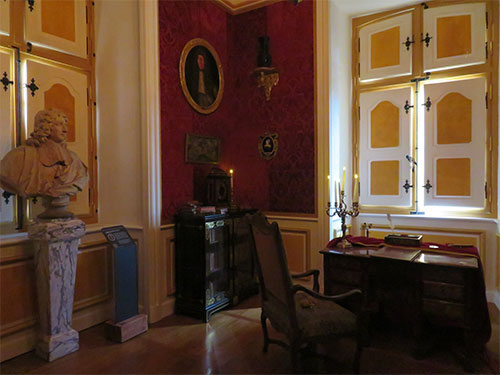
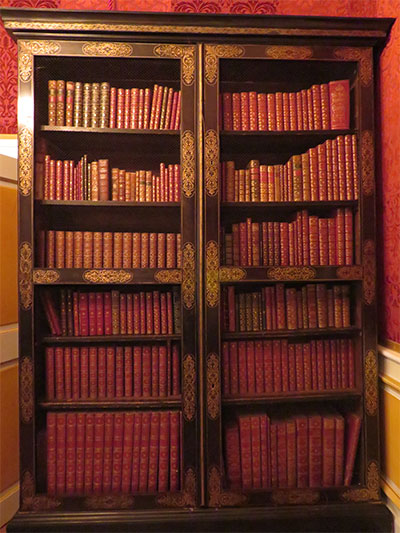
In 1961, there was a fire that destroyed a great deal of the castle. What we see today, has been restored to its original rooms. We went on a self-guided tour with a map of the castle’s journey through history. We began by walking through a large receiving room with a fireplace at each end. Then we entered the private apartments of the Marquis de Hautefort, consisting of his office, library, and sleeping chambers. In different rooms, a recording could be activated with a pushbutton, offering a conversation in English and in French. In his office, we listened to a conversation the Marquis was having with Colbert, the Minister of Louis XIV, about an agreement the two made about land for weapons.
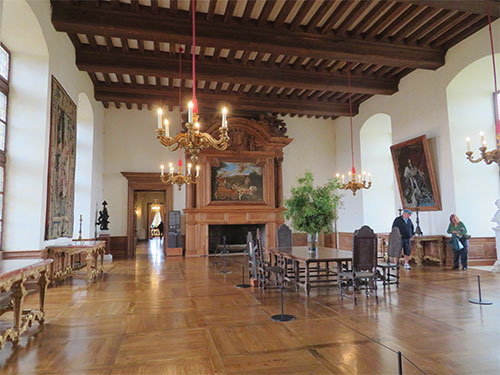
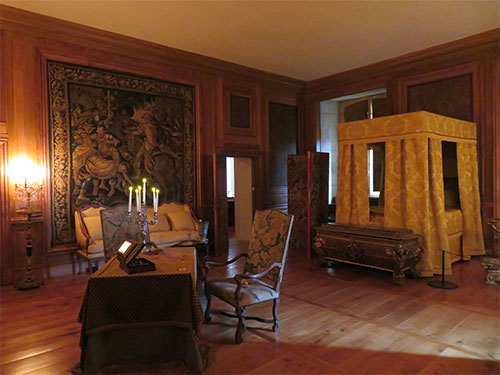
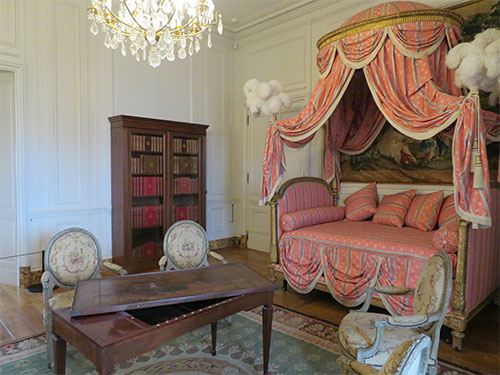
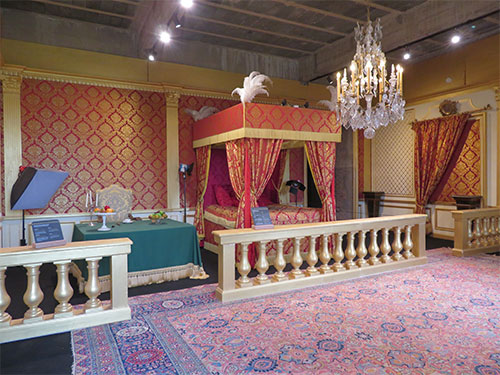
We went upstairs to what was once the banqueting hall, where the fireplace of carved walnut, rested below the Hautefort coat of arms, the same we had seen over the front entry. Then we went through the Madam’s rooms. There was her drawing room, with her daybed in pink, and her bed curtained with a Turkish canopy in her bedchamber. Both suites of rooms were filled with the furnishings and paintings from the 17th to the 19th centuries. A painting that hangs in one of the rooms with the title of “A Young Shepherd Pursuing his Flock,” was recently authenticated as a work by Fragonard.
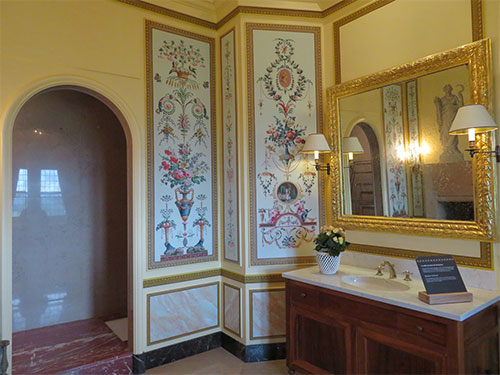
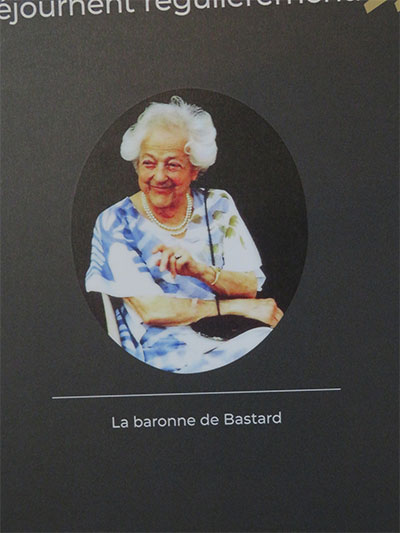
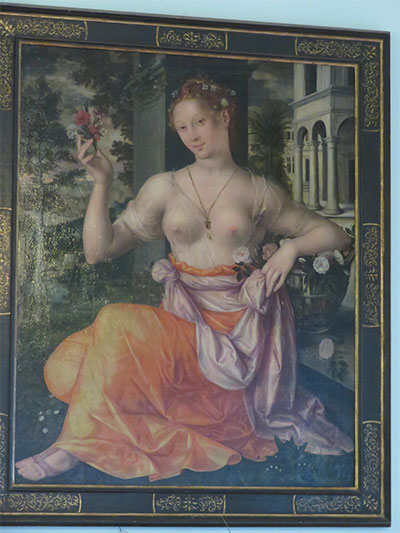
When the rebuilding of the castle was completed after the fire, the family moved back in, and the Baroness Simone de Bastard’s suite of rooms were also open to view. Within is a photograph of her, taken shortly before her death in 1999. She also has in her room, above the fireplace, a 1554 painting of Flora, the Roman goddess of spring and fertility.
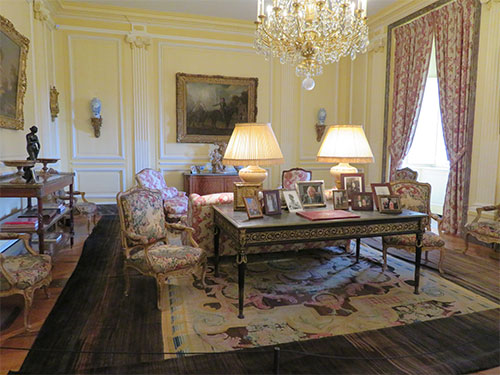
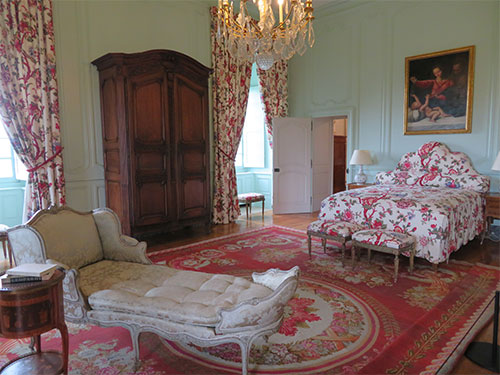
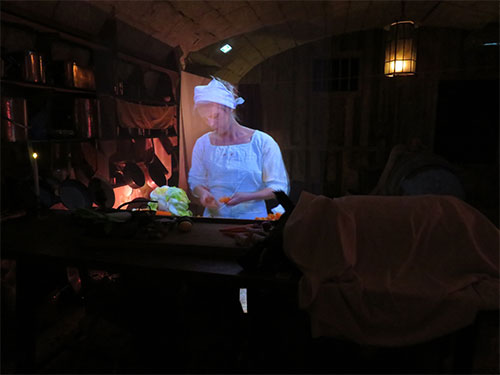
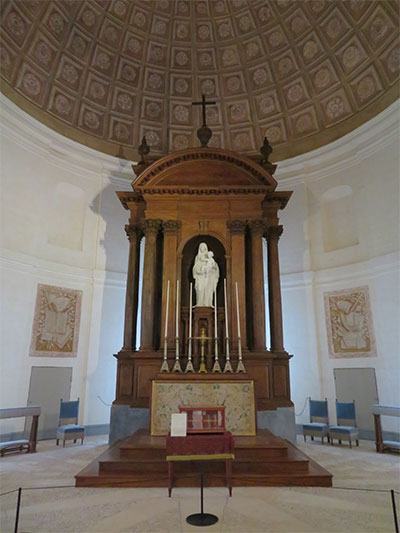
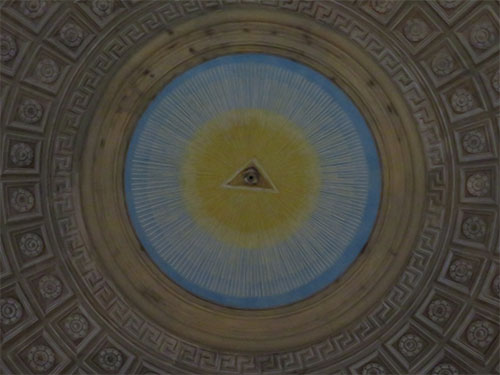
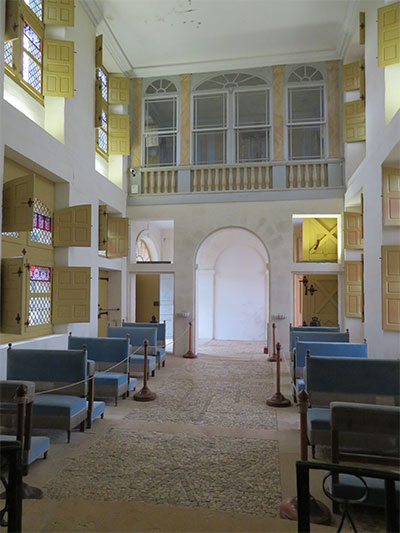
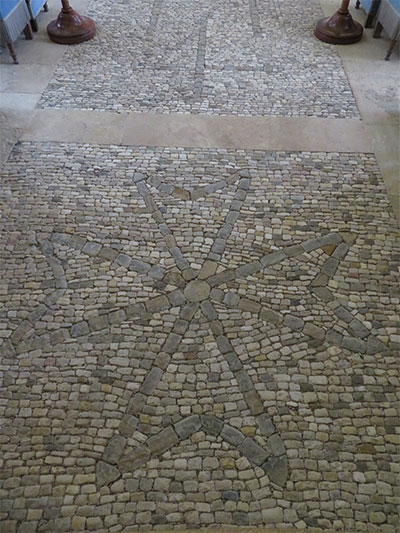
Then we went downstairs to the kitchen. We first came to the steward’s office with papers filling his messy desk. We pushed another audio button and heard him speaking aloud to himself about the costs of running the chateau. Within the kitchen, projections were seen of kitchen workers prepping food. At the end of the room, another projection of the steward is seen, yelling from the door, instructions to the cooks. There were other rooms that were just as interesting: the chapel with a Maltese cross on the floor and an all-seeing eye in the cupola, the tapestry room with 16th century Flemish tapestries, the movie room with a royal bed and photographs from two films produced on the premises: Ever After, A Cinderella Story (1998), and Eye of the Devil (1966). The outdoor covered gallery was also impressive, along with the front courtyard.
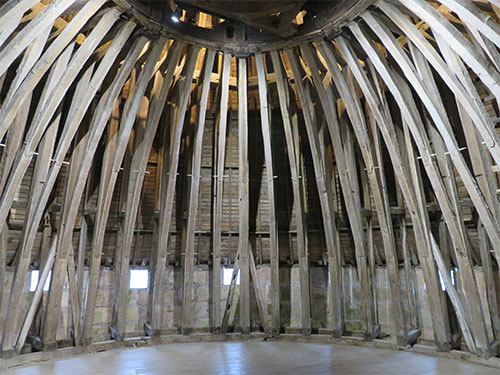
The attic was last, so we could see the old timber beams that had replaced the ones lost in the fire. A cinema room showed how the fire was started in the attic, in 1968. Across three walls, images of the fire spewed in a panoramic explosion in sight and sound, and then we saw what was left after the flames had died. Afterward, the people living in the castle, the Baroness de Bastard, Helene and Michel David-Weill, were interviewed. The Baroness declared that the castle would be rebuilt, and it has.
Perhaps because the family lived through the experience and had actually put it all back together, was in itself extraordinary; but also, the French gardens that surround the castle were even more so. They are typical with symmetry, geometric parterres, topiaries, alleys with trimmed hedges, and sectional areas with hedge designs, centered with flowers. It was early in the season for this garden, so the explosion of color that would normally be there was subdued, and the rain had beaten some down. Five gardeners were working while we were there. But the classical paths and boxwood plantings were perfectly laid out, even within the waterless moat.
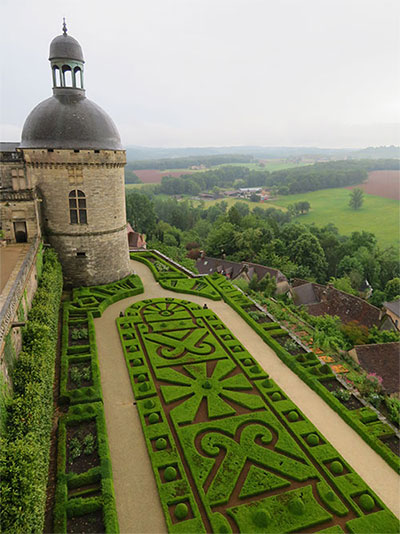
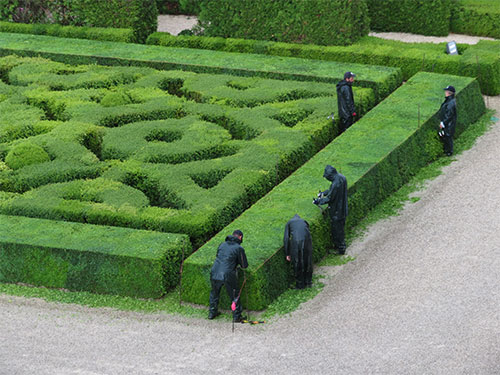
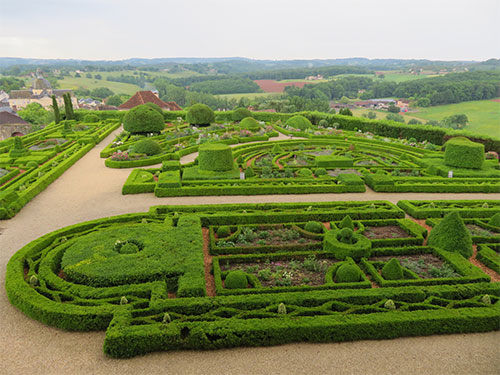
Despite that day’s rain and overcast skies, we had thoroughly enjoyed the castle with some of the displays that had just newly opened on May 1. Then of course, it was to the giftshop. I browsed while Vere climbed the tower to take pictures. I found a tapestry pillow with a deer on it, Vere got his book of the castle, and we bought a half bottle of honey wine made locally. Then it was back to the B&B for the evening.
 The official website of Lita-Luise Chappell, writer on sex, magic, food, distant lands, and everyday life with articles, poetry, novels, travelogues, rituals, cookbooks, and short-stories.