Friday, May 16
For our first breakfast, we took a table for two by a window that faced the verdant backyard. We were immediately greeted by our host, Didier. He came in to start the coffee machine and asked if we wanted yogurt, ham, or a cheese platter. I said yes to yogurt and the cheese, with a croissant and café au lait. Vere declined the ham and just had bread, butter, and jam with his tea. They had a jar of jam on each table. Ours was cherry, packed full with the fruit.
More guests arrived, a party of six and of two. One couple was from Canada and they had just arrived on their travels from Switzerland. The people at their table were four more Canadians, and an older French couple sat at a far table.
After breakfast, we decided to walk around the property and find the two animals the B&B had briefly mentioned, as living on the property; a donkey named Penelop (for Penelope), and a pony named Joker. We walked all around and couldn’t find them, but we heard a coo-coo bird, a woodpecker, and many more bird calls that we couldn’t recognize. Behind the building where our hosts lived, we saw a pond. As we got closer to check it out, we heard a duck quack, but no duck was in sight. It happened again, and then we were surprised to see that the sound came from a frog, a large Marsh frog. Then we redoubled our efforts for the larger two animals, and walked down between a long row of trees. Vere scouted ahead, spotted the donkey, and waved to me. We walked toward the covered pen, and we petted and chatted with Penelop and Joker.
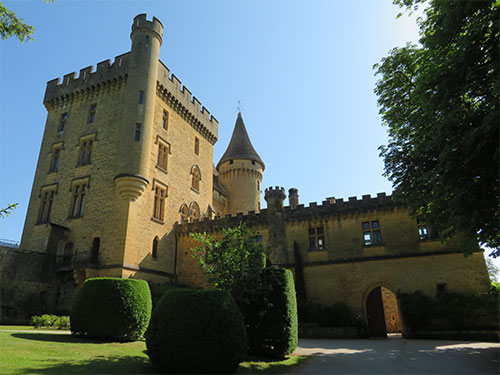
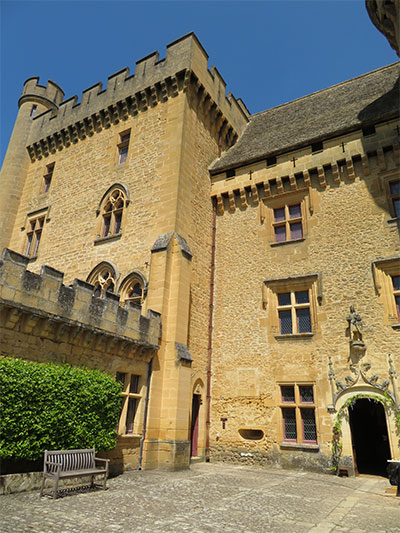
We returned to our room to relax until our first visit of the day, at Chateau de Puymartin. We arrived a little early, walked up the hill to the front of the castle, and got out tickets. Waiting for our guide, we sat on a bench under a tree, next to the entrance, looking up at the huge building.
The original castle dates to the second half of the 13th century. In 1357, it was stormed by English mercenaries, who looted, ransacked, and destroyed the roof to make it uninhabitable. In 1450, a powerful family of the Saint-Clars, rebuilt the castle, replacing all the roofs. This enabled the family to repel attacks by the Huguenots. In the 17th century, Suzanne Saint-Clar became the owner, but in the 18th century it was abandoned. In the 19th century, the Marquis Marc de Carbonnier de Marzac bought the castle, restored it in the neo-Gothic style, and kept it in the family. At the end of the 19th century, it was finally renovated with the romantic luxuries one sees today, with silk tapestries, mullioned windows, plush carpets, statues, and paintings. In 2003, Count Henri de Montbron’s wife and children inherited the castle, and live there still, in a separate wing.
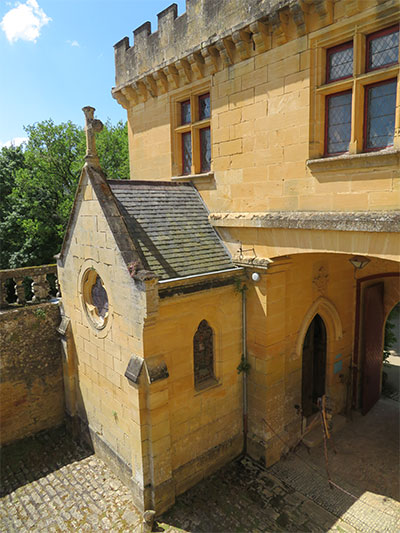
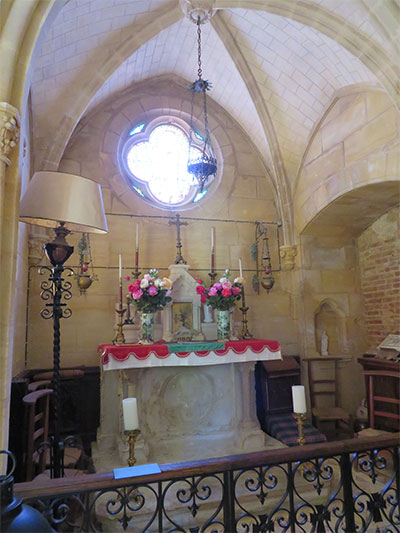
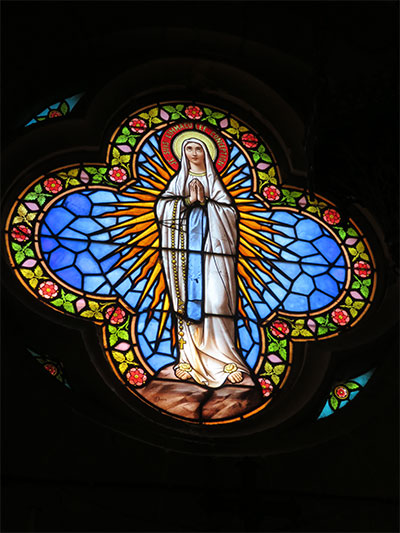
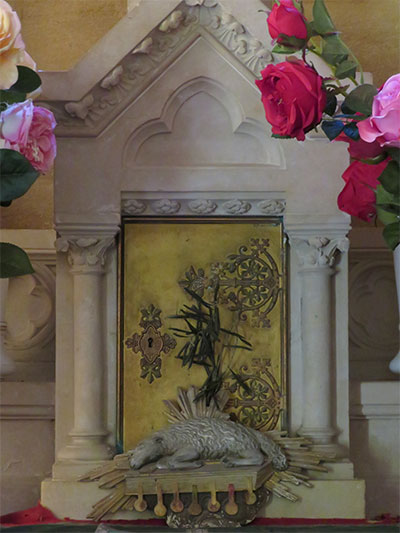
We were met at the red front door by the same young man who sold us our tickets. One other couple joined us for a tour in French. As soon as we walked through the large front doors and into the lower courtyard, there was a very small chapel to our right. Marc Carbonnier de Marzac was a strict Catholic, devoted to Saint Louis and the Virgin Mary. He and his wife, Marie Louise de Pichard de La Tour, made many trips to the Lourdes sanctuary, praying for a child. Then a miracle happened, she conceived at the age of forty-five and they had a girl named Marie-Thérèse. Monsieur Carbonnier then had the chapel built to give thanks to the Virgin Mary. Every year on August 15th, at the Feast of the Assumption, a private Mass is held.
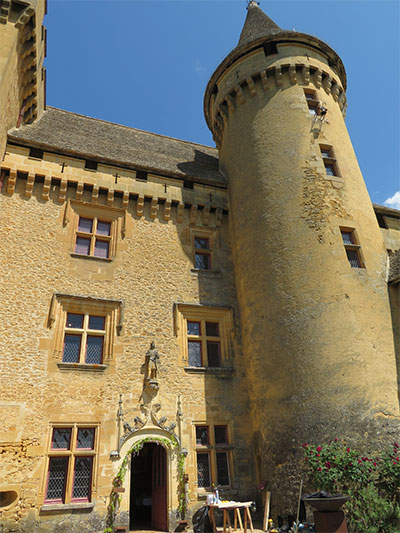
Our guide led us up the stone stairway on the left, to an upper courtyard with wide stone decking. When we turned toward the castle it had green vines growing in an arc over the main entrance. We could also see four more levels and a round tower with a conical roof, above.
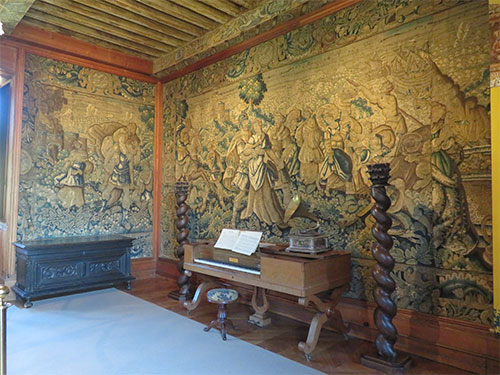
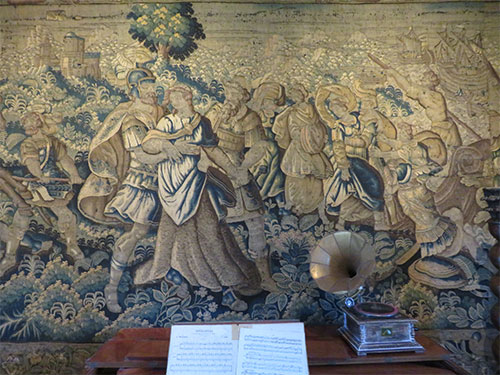
We entered and would be visiting twelve special rooms. The first large room was decorated by Cours Saint-Louis. There were family busts, family portraits, and Aubusson tapestries hanging from each wall.
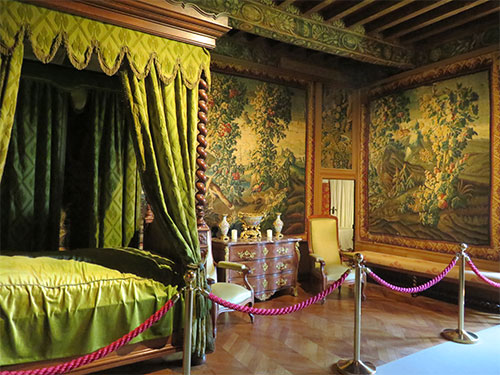
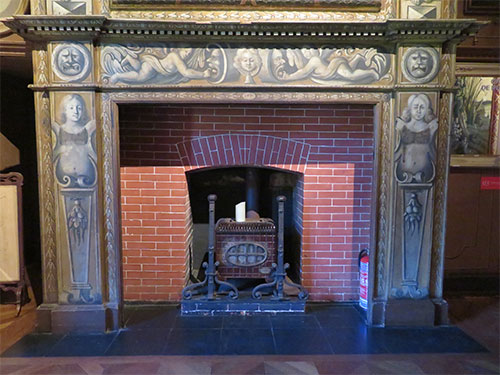
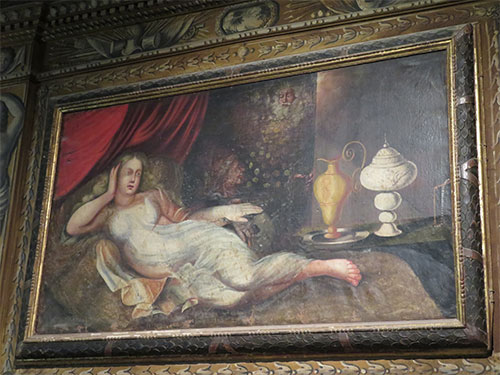
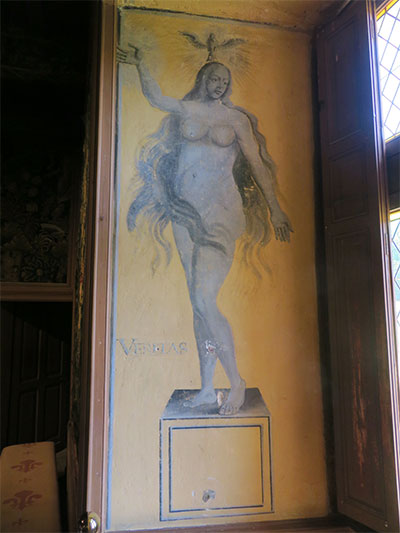
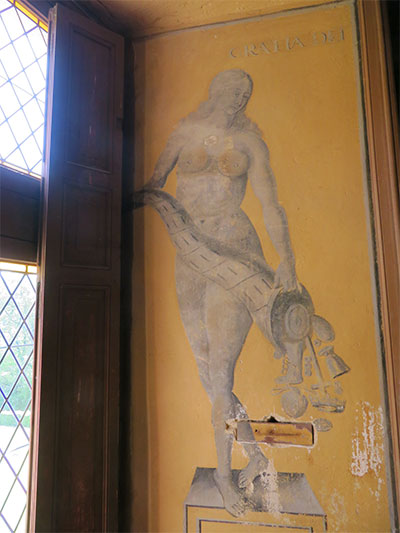
We were led up a 15th century spiral staircase to more rooms. Here was the chamber of honor, where the marquis slept. The main bedroom had a box bed with green drapes, and tapestries on that side of the room. Across from the bed was an ornate fireplace that had ornately painted women on either side. Above was a painting of a nude woman laid out on a bed. The castle had originally been filled with paintings of naked women, but when Catholicism took hold of the country, the family had to paint faint clothes across their bodies. Women were also painted on the window shutters.
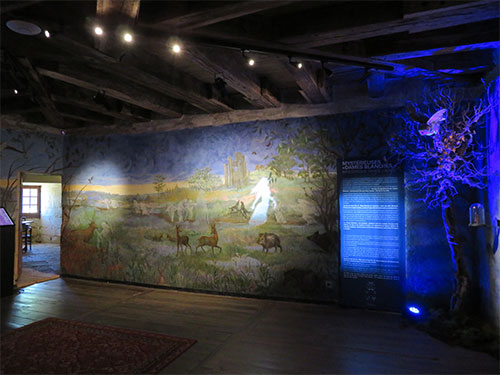
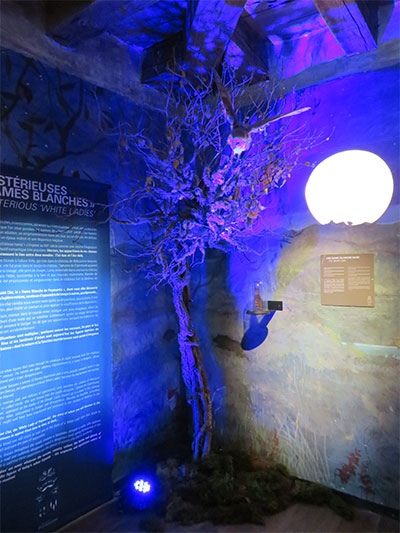
We climbed higher and came to an unusual room, decorated with the intention of introducing the legend of the Mysterieuses Dames Blanche (Mysterious White Ladies). It could be one woman or several, and this diaphanous apparition occurs at dusk and at night. The story behind the figure emanates from the 16th century about adultery, imprisonment of a woman in a tower, abuse by a violent husband, and a tragic disappearance which haunts the castle to this day.
The room appeared to be part fantasy and part sitting room, filled with odd things in odd places, an owl in a branch that came out from the wall, with a large white moon painted on the wall behind it. Other art on the walls were examples of where the female apparition appears, greeting wild animals of the forest, such as wolves, deer, boars, along with other mythical animals, and objects like butterflies in glass on one shelf, chests draped in clothes the white lady might have worn, and other mystical items.
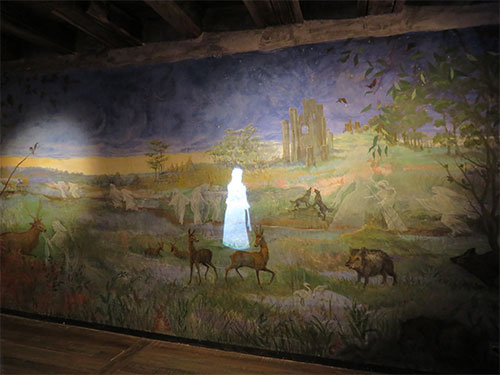
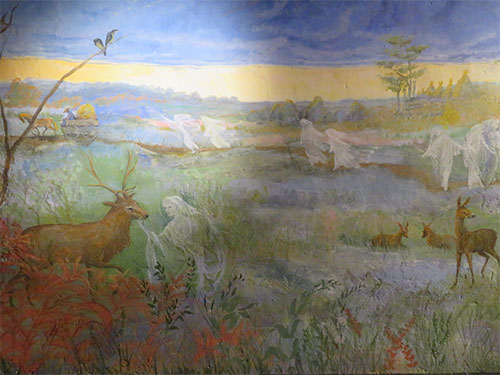
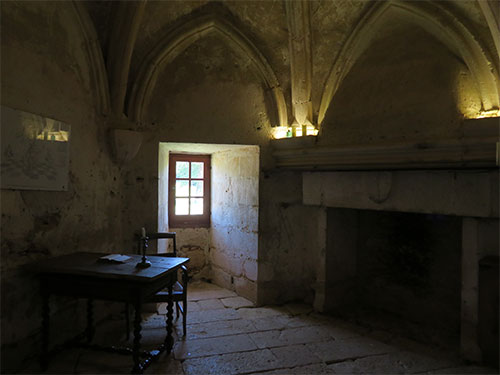
Just beyond this room was a rather small plain room in a tower. Our guide related the famous legend of the White Lady as part of Puymartin’s history, a sad story about Thérèze de Saint-Clar. Her husband, having come back from war earlier than expected, surprised her with a lover. Angered, he locked her in the tower room as punishment for her betrayal. She was imprisoned there for the rest of her life. After she died, it is said her tormented soul returns to haunt the castle. The owners have seen it, Count Henri de Montbron has seen her several times in different rooms of the castle and so has his son, as well as some guests who have stayed the night, and even some visitors. This legend contributes to the fame of the castle, and many a gift shop earns from the sale of the same book about the legend.
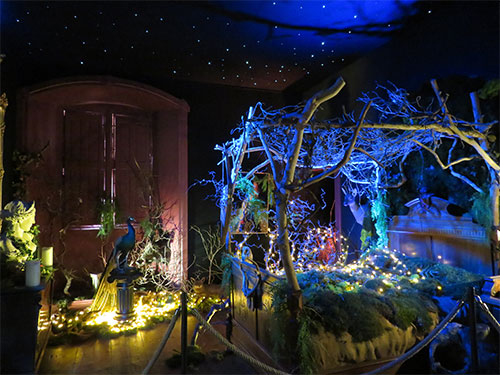
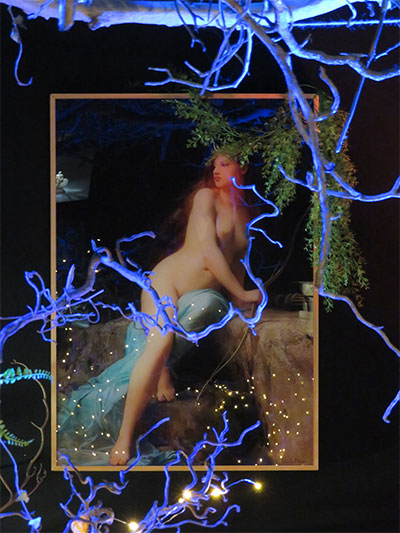
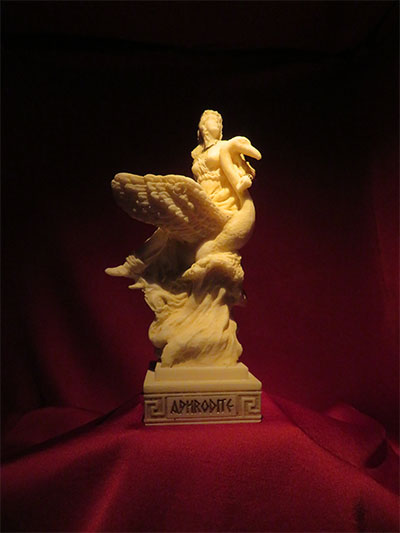
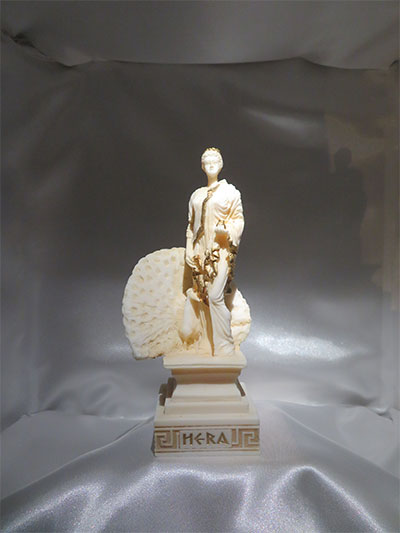
Another room in the castle was of fantasy, dedicated to the Greek Artemis, goddess of the hunt, wild nature, and the moon. The room was darkened with a dark blue, starry lit painted sky. Tree branches emerged from the walls in every corner. The bed was laid with a bed of moss with fairy lights. On the far wall was a picture of a beautiful woman. On the wall to the right were sectioned shelves, displaying small individual statues of different goddesses, two of them being Aphrodite with her sacred animal of the swan, symbolizing her grace and beauty, and Hera with her peacock.
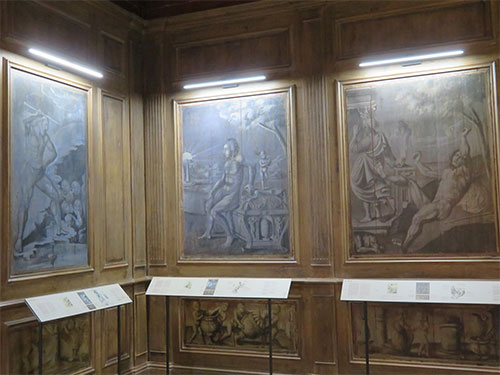
In another large room, was a salon of paintings of mythological characters. The framed art used to hang in a room off the marquises’ bedroom, but that room was badly damaged by water, so they moved the entire collection to a larger room, called the Cabinet of Mythology. The “cabinet” was a private place for the owner to work and contemplate. The gentry had to overcome the weaknesses of the human soul, balancing their power, courageousness in war with its destructive passions, and maintain the illusion of keeping the mind free and merciful.
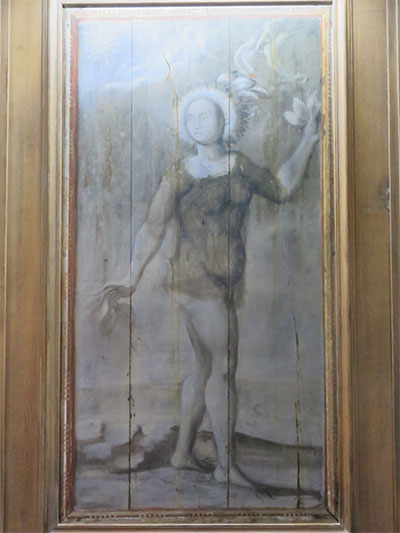
The room is composed of eight wooden panels entirely painted in grisaille (a gray tint), created between 1670 and 1682 by Philippe Lemaire, for the lord of Puymartin, the owner at the time. Each reproduction offers a detailed analysis and is associated with references in Greek mythology. The pictures tell the story of Argos (a many-eyed giant who served the goddess Hera), Bellerophon (a divine Corinthian hero, who slayed monsters), Oenus (famed king of Calydon and wine-maker), Perseus (hero, who slayed Medusa and married Andromeda), Meleager (a hero and prince of Calydon, who hunted the Calydonian boar, and participated in the quest for the Golden Fleece), Memnon (Ethiopian king and hero of the Trojan War, renowned for his strength and skill as a warrior), and Clytia (a water nymph, who tragically fell in love with Helios the sun god). Clytea, pictured, is shown as another figure who originally was naked, but later was painted clothed. The gallery presentation is a combination of moral, political, and religious propaganda. The collection became a historic monument in 1977.
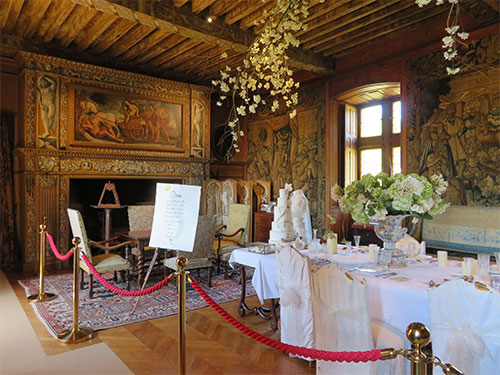
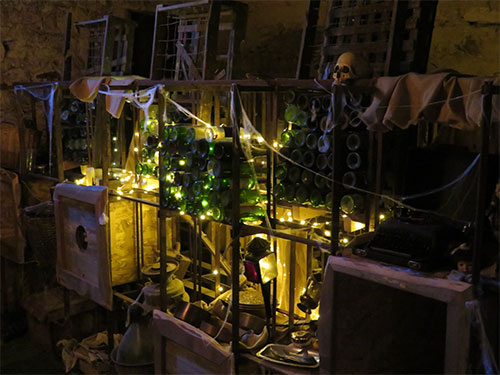
In the large dining room downstairs, a long spray of May flowers made of yellow silk, hangs above the large table; and the surface of the table is fully laid out for a sumptuous meal. A three-layer cake sits at one end of the table, and a mounted placard lists the courses once offered. It listed Cream of Chicken soup, Ham in gelee aspic, Salmon tartare, Fillet of Beef with Emerald sauce (a green sauce made of lime, cilantro and ginger), Foie gras crumble, Guinea fowl, Russian salad, Ice bomb (like a Baked Alaska but covered with chocolate instead of meringue), Petits fours, and other assorted desserts. We were also taken downstairs to the cellar.
Afterward, we went into the gift shop, and the same young man was minding the store. I bought a coffee cup with beautiful birds on a spray of flowers, and Vere bought a book about the castle with pictures of each room, and about the legend of the white lady. Puymartin was one of the most fantastic castles we have ever been to, ranging from authentic and historical to legendary and imaginary.
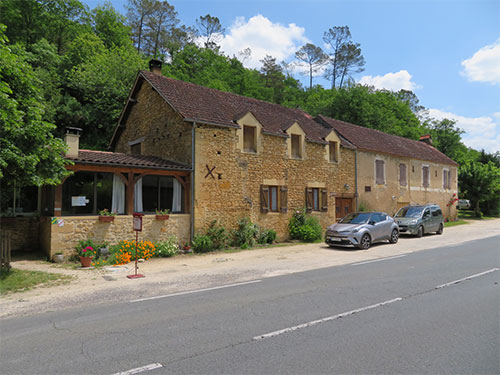
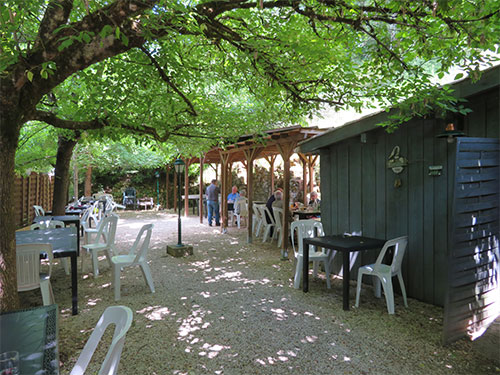
After that, we needed to ground ourselves from any illusions, and stopped for lunch at a roadside restaurant, called the Auberge Lacombe (Lacombe Inn). It touted a menu with canard (duck) on every offering. We chose to eat outside under the shady terrace. Even though the sound of cars on the road whizzing by was just a few yards away, we soon tuned them out to enjoy the setting and the food. Vere had the sample plate that offered different ways of eating duck, from the dried and smoked to a fresh terrine. I had the only thing on the menu that was not of duck, the Salad Végétarienne, but the vegetarian salad also had a hard-boiled egg and tuna on it. Fortunately, I eat fish, but the mound of lettuce that was under it was piled so high, I could only eat a third of it. Vere had a soda, and I ordered a non-alcoholic drink called a Bora-Bora, with orange, lemon, pineapple, and cherry juice. The rim was coated with pink sugar, and each sip was fruity good.
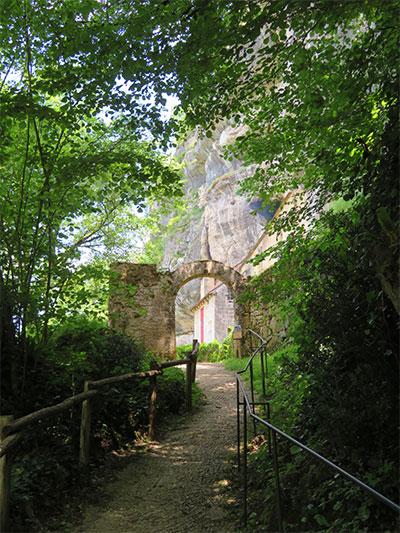
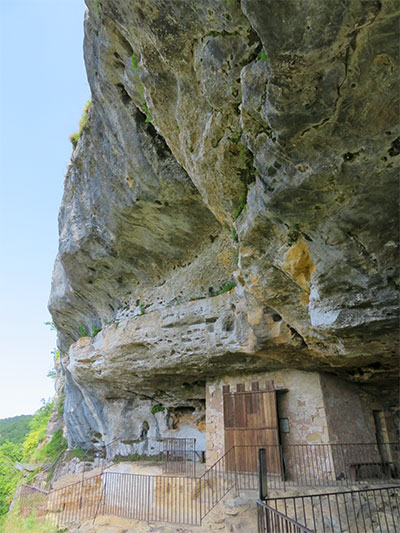
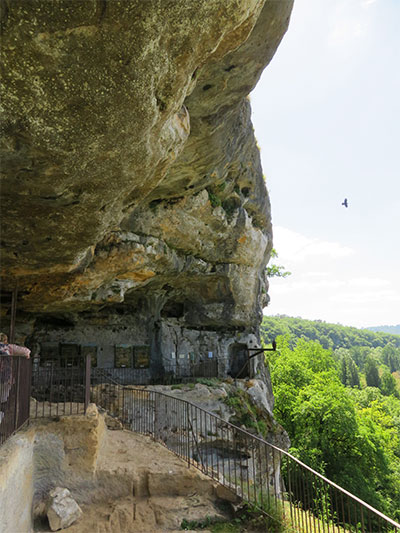
Then we headed to our next site, Forte de Reignac (Reignac Fort). We parked across the road from the fort, and from there we got a good look up at the cliff. Above a grassy rise was a stone wall, and above it was a long yellow building with windows and red banners. Then our eyes moved further upward to see several horizontal levels cut into the stone cliff. We crossed the road and followed the signs up a winding shady path, smelling the smoke from a fireplace, until we reached the building, which turned out to be three-stories high.
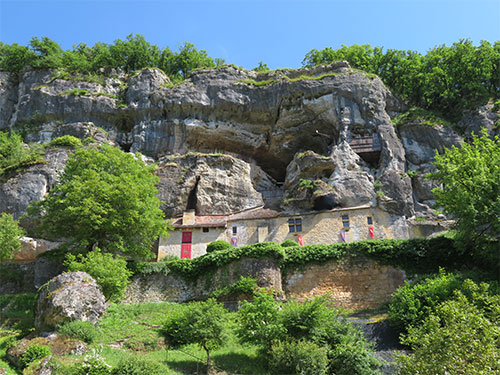
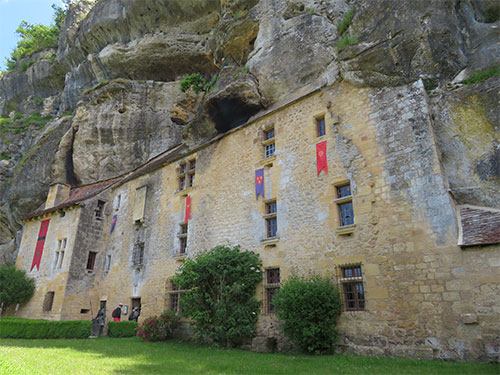
This incredible castle was built directly into the cliff for habitation since the prehistoric Magdalenian Period (17,000-12,000 BCE), as many chipped flints were discovered on the site. This highly unusual castle began as a troglodyte dwelling in the 10th century, was fortified in the 14th century, and then with windows that date to 1508. The descriptive booklet that we carried, described Reignac as not only a powerful lair on the side of a cliff, it was primarily the center of an estate where the lord lived with his family and household. Lord Jaquemet de Reignac dispensed justice over the nearby troglodyte city of La Roque-Saint-Christophe. He was considered a cruel lord, and a torture chamber in the dungeon justifies the description.
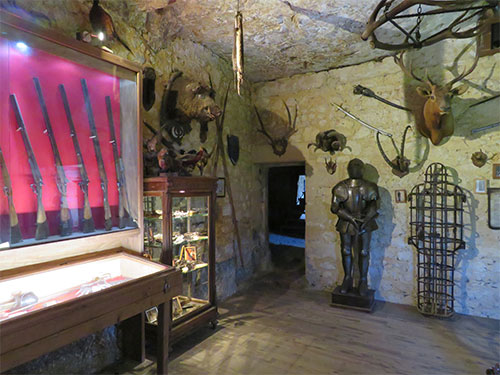
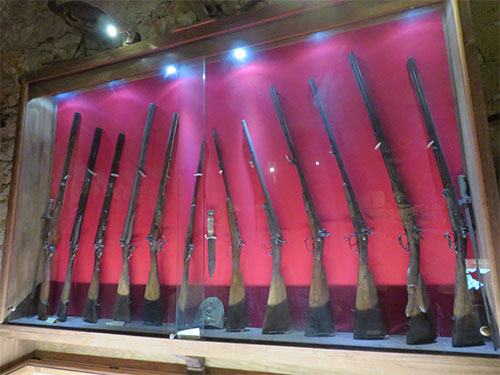
Because of the fort’s unusual placement, located over 130 feet high, and tucked under the cliff face, it could easily be defended from attacks. Then in the early 1500s, twelve gunports were installed. These added to the owner’s arquebus, musket, crossbow, and flintlocks, but the refuge was never attacked. However, in the event of an attack, every man, woman. and child had their assignment to defend it. Reignac is the only cliff-side chateau to have survived in its original condition, from Cro-Magnon man watching from its heights for herds of wild game, to the middle of the 19th century comforts of an aristocratic dwelling.
Once we entered, we discovered that every step, each wall, floor, and ceiling had been hand-carved from the cliffside stone. Recorded sounds of early inhabitants going about their business lent an acoustic addition to what we were seeing. In later years, wooden stairways and walls were added.
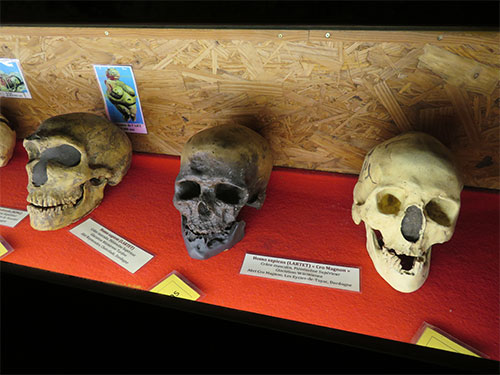
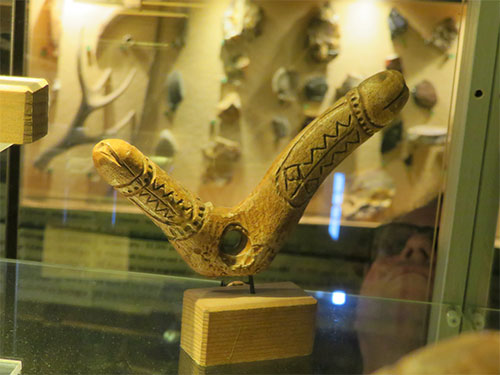
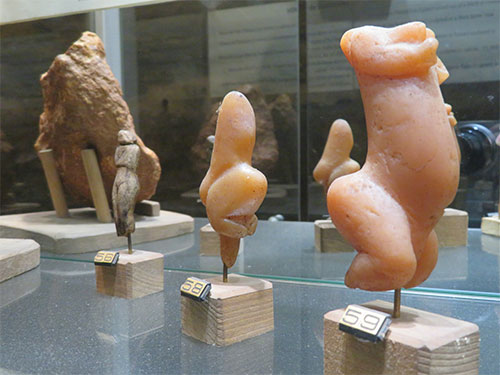
The first large, carved-out room on the ground floor was a museum, showing all the flints, arrows, and ancient tools found in the area. It included an exhibit of famous Venus representations from around the world, and a progressive series of human skulls from early man to present. None of the goddesses or skulls were found in or around the fort, but they did serve to show how man himself had changed in appearance and his understanding of the female body, before and while the cliff had been occupied. There was even a 13,000-year-old double phallus. A prison cell was at one end of only thirteen square feet, where captives were held, pending a paid ransom.
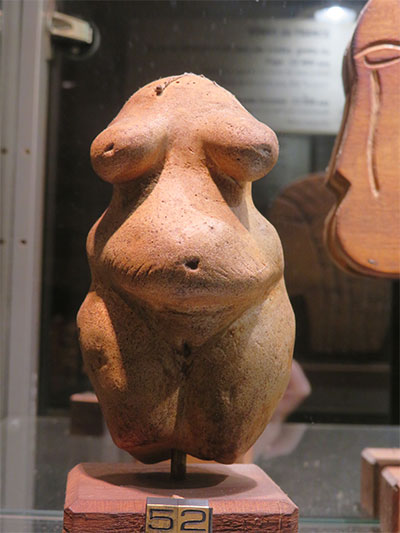
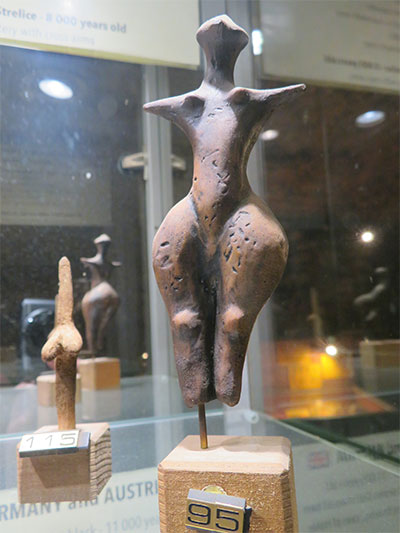
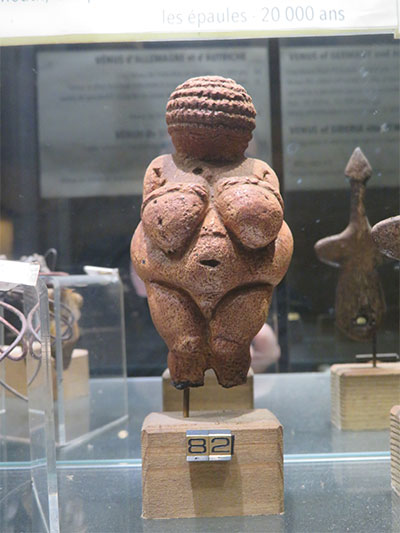
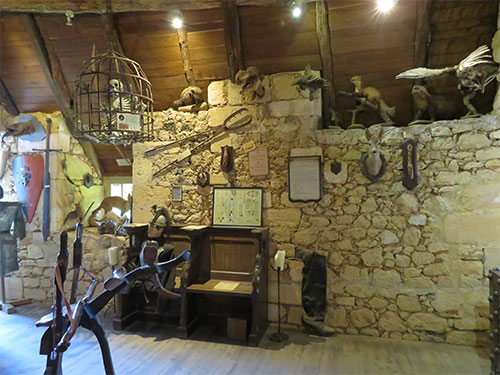
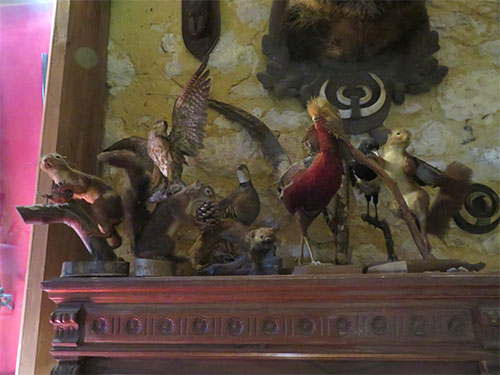
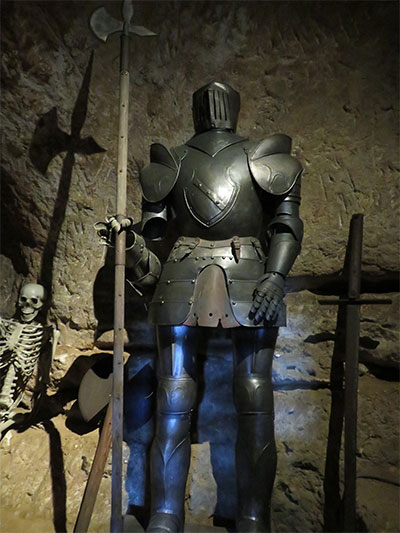
As we progressed higher, we would walk into where successive families had lived through the centuries and what they would have had around them. On the way to the next level, along the edges of the rocks and mounted on the walls, were taxidermy animals of all kinds. The armory was filled with all sorts of weapons, suits of armor, along with manikins that wore the dress of the 1400s. A small chapel was to one side with a sparse altar and a priest’s chasuble.
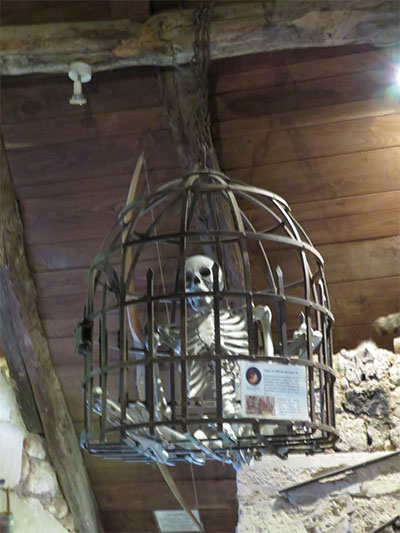
Another room off to the side is said to have been used by the Billy Goat of Reinac, who lived for a time in the fort. A novel by Eugene Leroy Jacquoule Croquant, tells of an evil character called that. He was a man fierce and cruel, as he exercised his “right of the first night” on girls in the region. He required every pubescent girl to work for several weeks as a “maid for everything” under the right of servitude. The man was suspected of assaulting and robbing travelers and merchants, his face hidden under a rabbit skin. The room was so small, it certainly would not have allowed a young woman to escape him, and not surprisingly, is said to be haunted.
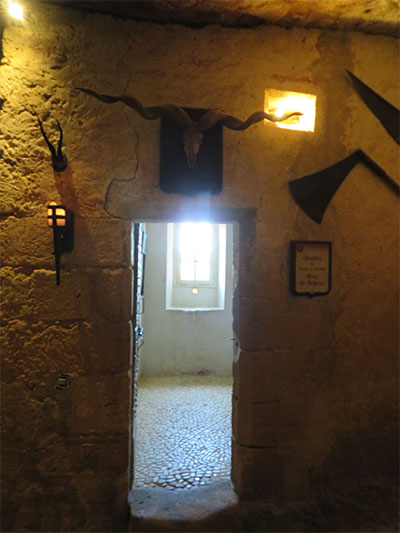
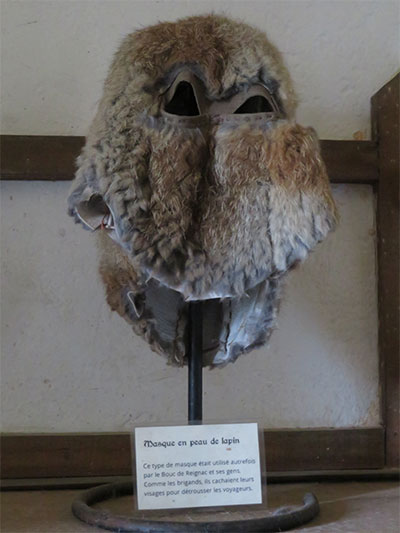
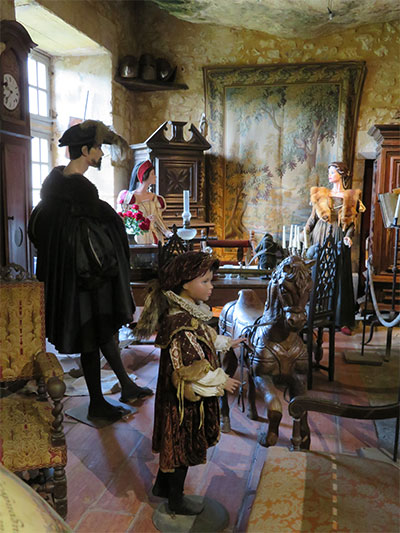
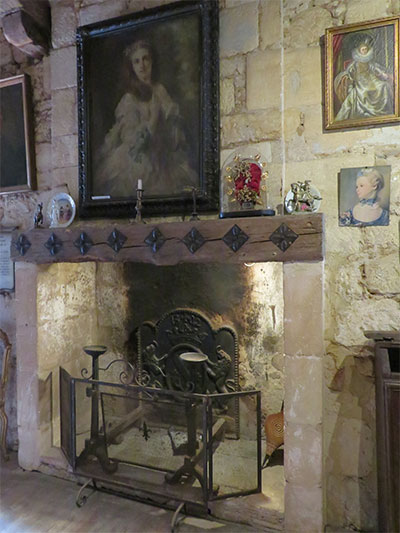
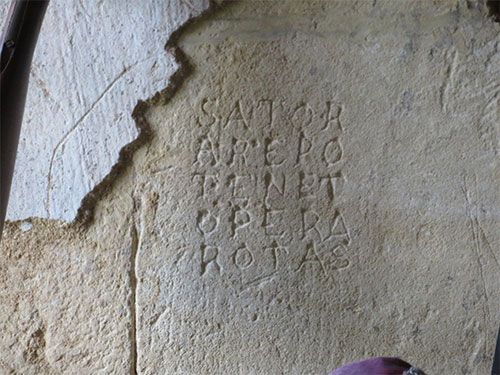
On the next level was a room from the 1800s. A fireplace was burning wood, the smoke of which we had smelled climbing to the site, as natural conduits were open to the outside. In one wall was a small iron cabinet with a heavily locked iron door, which once held herbs, medicines, and poisonous items. There were a few paintings, the furniture was of heavy dark wood, a few tapestries hung on the walls, and animal trophies were mounted of deer and boar. There was also a board with magic numbers in one corner, a protective Sator square with its palindromes, and art etched into the walls. In a room to the side was the bedchamber, with another fireplace. Lit candles, open books, and hanging clothes were observed, as if someone had just left the room.
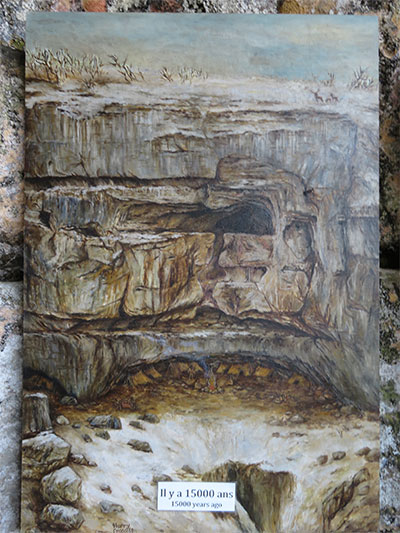
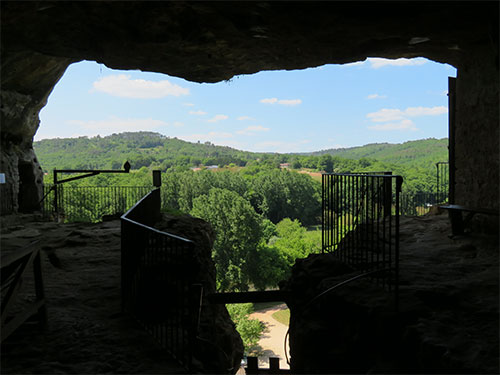
Up some wooden stairs we reached an open terrace of rock that had been leveled out, where lookouts could see if an enemy was approaching. The cliff receded under a huge stone roof, and there, a TV screen softly ran, telling the history of the area and of the Reignac cliff castle. The wall also displayed a series of paintings on how the building had progressed through the centuries, getting added on to, floor by floor.
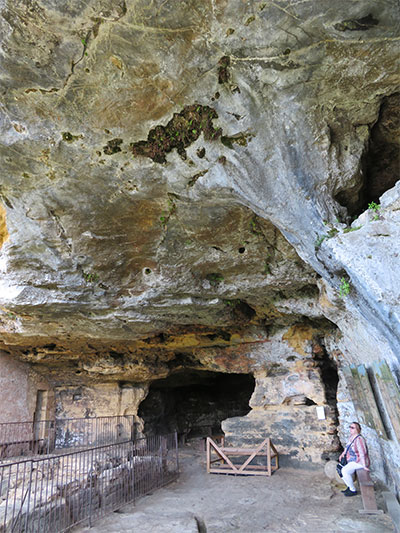
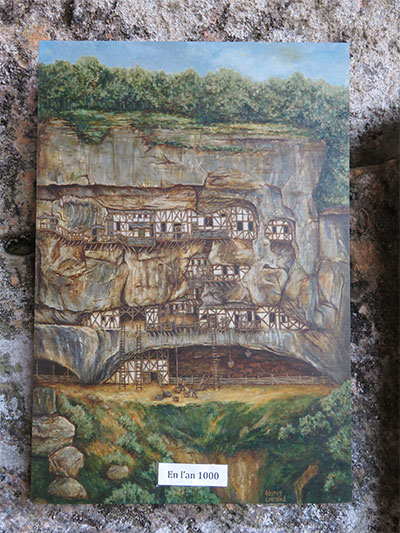
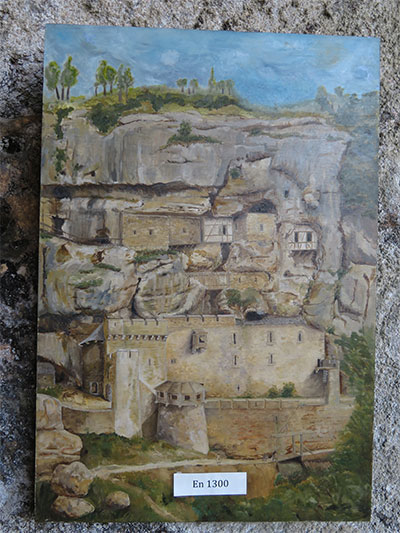
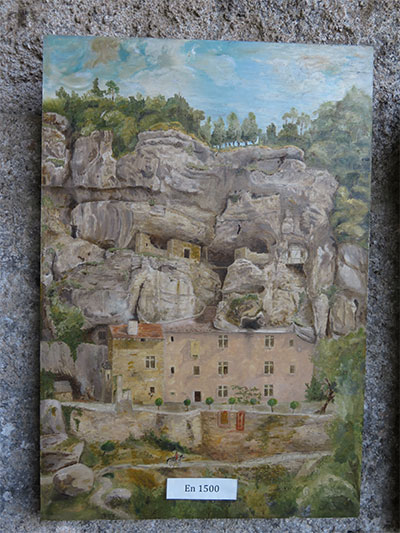
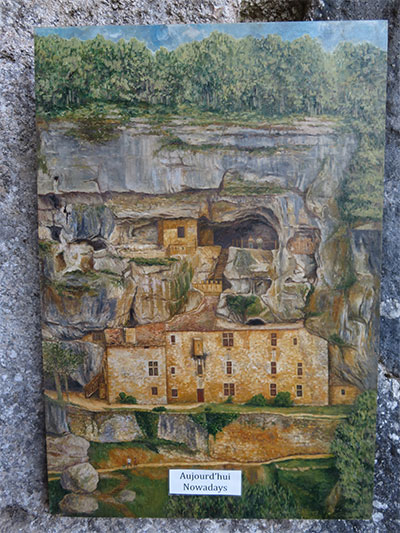
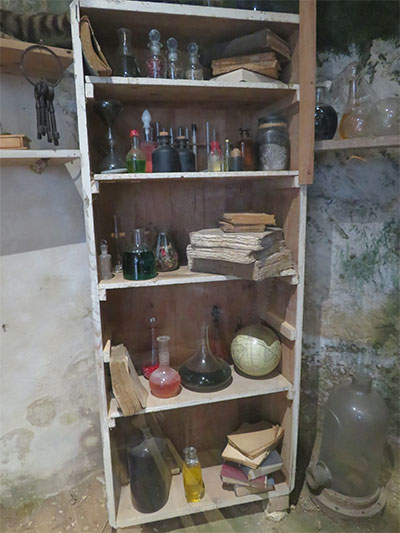
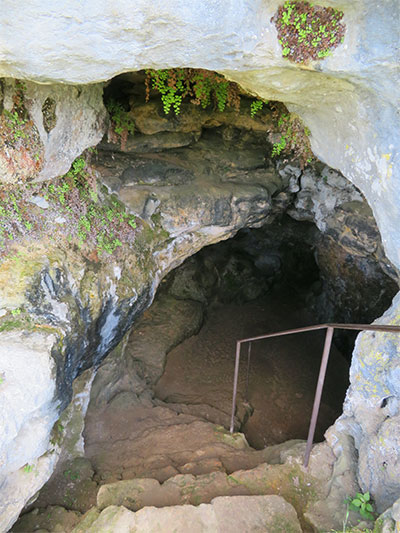
Also on that level, was a small room that had been inhabited during the Middle Ages by an alchemist. Odd bottles and items were laid on a shelf to show his work. At the far end of the terrace was a dirt cave that went down into the hill. It is suggested that it may have been where the marquis hid all the gold that had once been lead, or he was hiding a coin counterfeiting business.
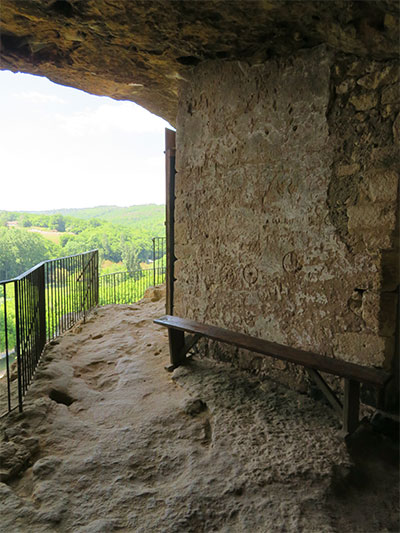
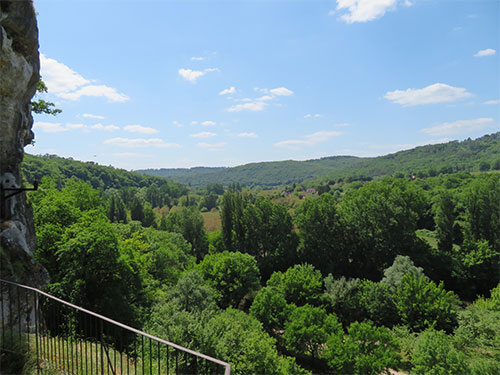
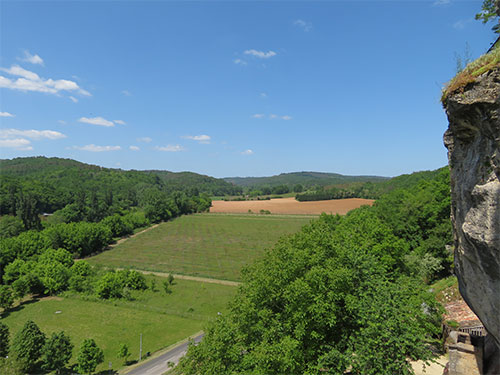
At the other end of the terrace, when no one else was around, we sat on a bench and enjoyed the view of the countryside from that level. We also could watch the swallows and swifts fly and dart in and out of small holes in the rock. Then we closed our eyes, listening to their cries and imagined how it must have been living up on that cliffside thousands of years before.
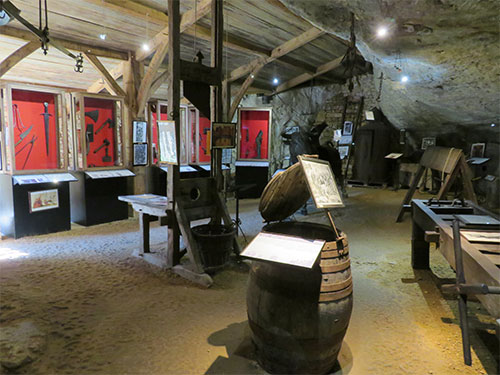
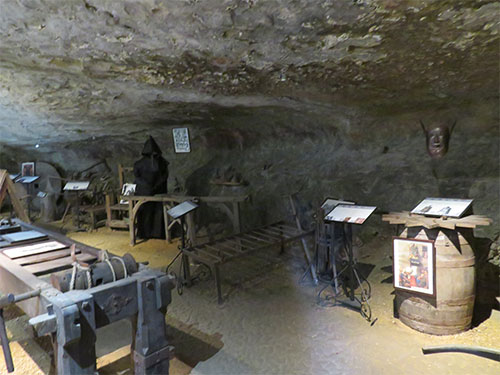
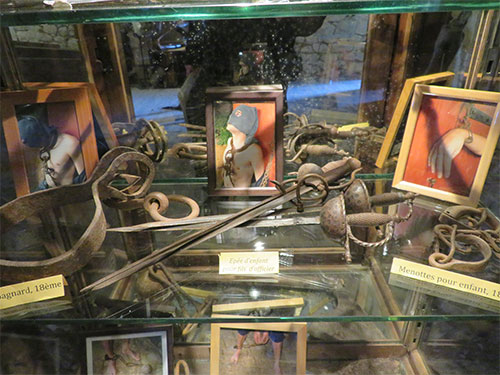
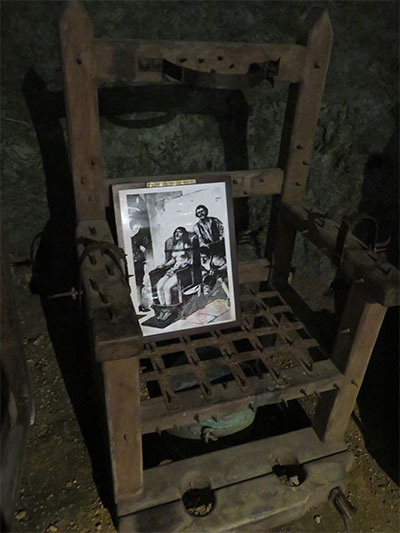
The final level, all the way back down to the ground floor, was a very large room filled with instruments of torture, which usually slowly killed the victim. Aside from the usual spiked collars, stretchers, and other assorted torturous tools, was an iron maiden; and a large iron bull where someone was locked inside and the underside was heated by fire. It was said that the person inside while dying, would bellow like a bull.
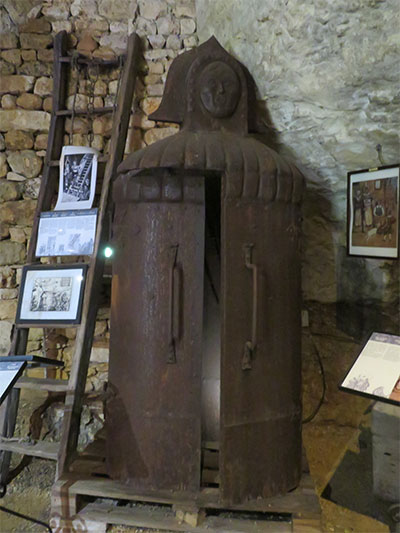
Then finally, of course, was the gift shop. We bought a book on Forte de Reignac with a magnet of her mascot, a gray cat named Merlin, who we met on the walkway up to the chateau.
Fairly exhausted by then, we headed back to our B&B, set up our laptops in the dining room, and did some writing.
At 7:15, we left for dinner to Restaurant L’Esprit (Restaurant of the Spirit). We decided to have two glasses of sauternes and an appetizer of three different cheeses: Tomme and Crémeuh from La Brunie farm and Echourgnac sheep’s cheese, served with black cherry jam with Espelette pepper, salad, and walnuts. Then Vere had the beef hanger steak with a Rocamadour cheese and walnut sauce. Rocamadour cheese is a soft and buttery French goat cheese that has a nutty flavor with a hint of caramel. I had the marinated yuzu-sesame shrimp, avocado tartare (cubed avocado- not guacamole as I had thought), with feta cheese, and two triangles of crispy flour tortillas, covered with mild spices. For dessert, Vere had a dark chocolate panna cotta with a broken peanut cookie crumble.
Afterward, it was back to the B&B, and back to our laptops for a short evening catch up before bed.
 The official website of Lita-Luise Chappell, writer on sex, magic, food, distant lands, and everyday life with articles, poetry, novels, travelogues, rituals, cookbooks, and short-stories.