Sunday, May 18
We got up earlier for two reasons. One, our B&B hosts had extra guests which necessitated separate dining times; and two, we had a 10:15 reservation at our first site and it was an hour away. So, we were up with the first service and then departed.
Gouffre (chasm) de Padirac was an hour and five minutes away in the commune of Padirac. It was a place where water had caused a sink hole with the land falling down hundreds of feet, which formed a river channel that could be explored. I’d visited this amazing place in 1983, and it was so spectacular, that I told Vere about it repeatedly, so I had to show it to him. We arrived fifteen minutes before we were to be admitted, as instructed.
Here is some of the cave’s history: In 1907, at the base entrance of the chasm, there was still a small dry stone wall and the remains of a hearth. Armand Viré believed that these remains had been left by men seeking refuge, who had been defeated during the Hundred Years’ War (1337-1453). Ashes, coals, kitchen debris, and weapons were found and subsequently displayed to the public in a glass case at the entrance to the chasm. This part of the cave had also been inhabited later in 1595, when men took advantage of the climatic conditions to extract potassium nitrate (saltpeter).
Between 1865 and 1870, Édouard-Alfred Martel and Count Murat de Salvagnac, descended into the entrance shaft in a large basket. But they did not notice the small opening that leads to the large cave gallery. In 1889, the speleologist Édouard-Alfred Martel and a local village priest, discovered the underground river of the Padirac chasm. They only got so far, when the water got too deep to trudge through, so they returned the next day with a small boat. They got much further then, and explorations continued for years with different speleologists and explorers. The cave was first opened to tourists in 1898, with a walkway and metal staircase. In 1900, electric lighting was installed, and today over 500,000 people annually enter the cave, which holds the record for the most attendance for underground tourism in France.
It has a monumental opening entrance of nearly 3,280 feet across at the top, and its center which dramatically sank millions of years before, fell 338 feet down. An underground river through a limestone plateau, travels just over thirty-five miles. The elongated cave intersects two ages, the lower to Upper Bajocian period, and the upper dating to the Lower Bathonian Period (approx. 170.9 to 168.2 million years ago) in the Middle Jurassic period.
Before entering, we were given headsets, so our guide could describe what we were seeing. When we emerged from the elevators, we were able to look up and see the formation of the walls and how far down we had come.
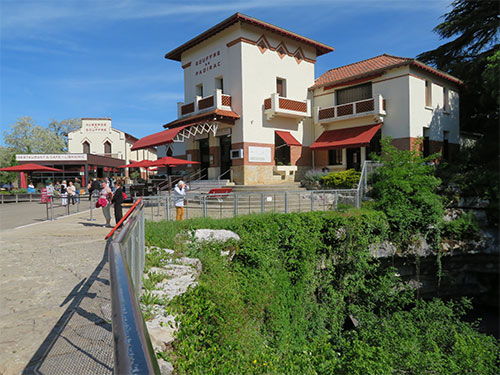
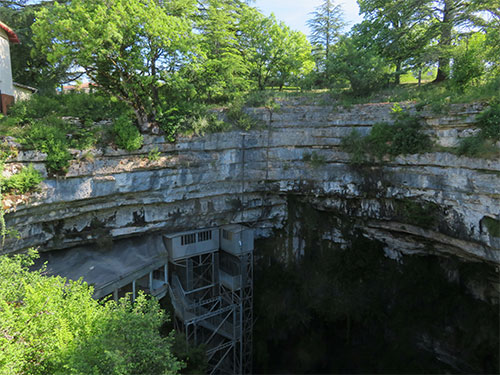
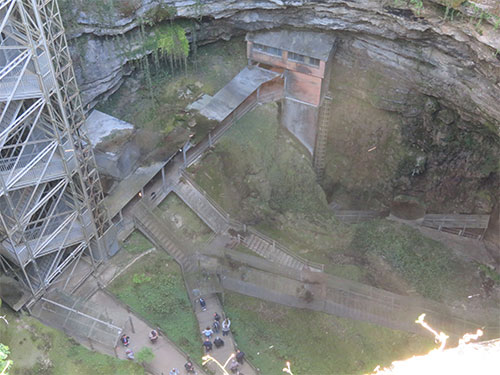
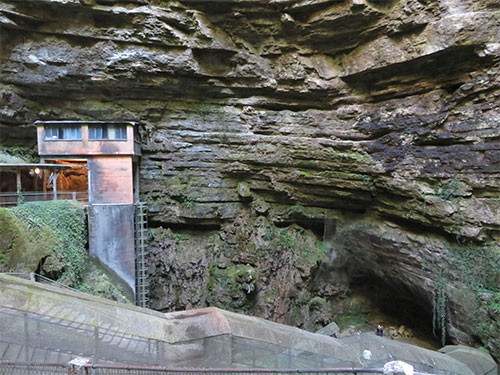
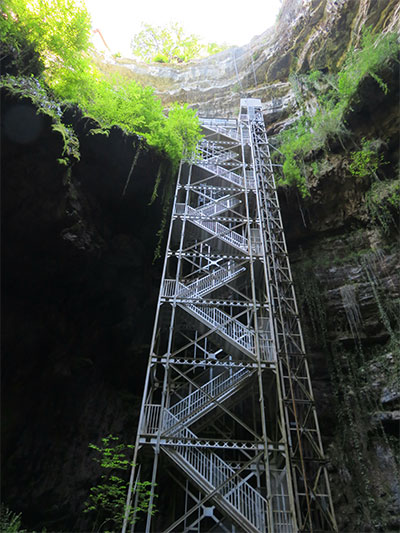
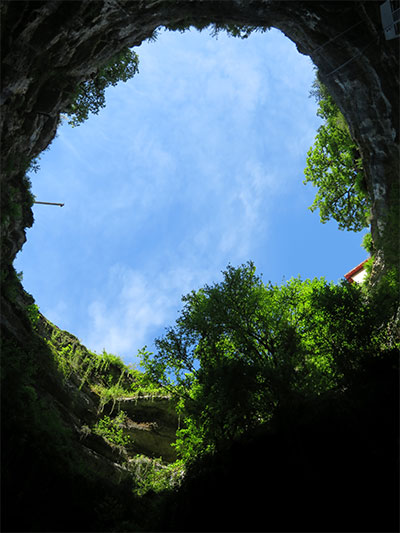
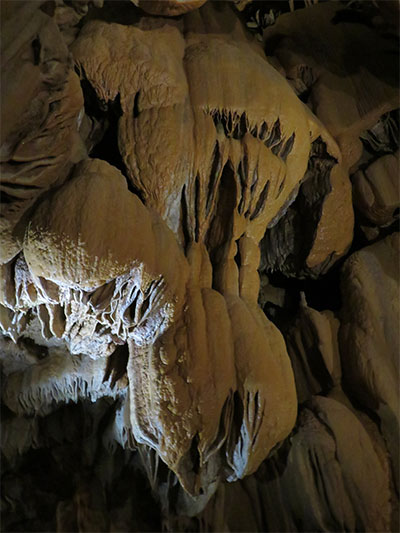
Different galleries of the cave are filled with the usual stalactites and stalagmites, curtains, and various other cave formations. What makes this cave so unique, is that we could descend via two elevators, follow a path through the cave galleries, then get into boats that hold eight people. A guide in the back of the boat, with a long pole to steer, took us down river. Then we got out, walked further with hundreds of more stairs to the grand room.
Vere took lots of pictures within, but as with any enormous space, especially within a cave with limited lighting, it is nearly impossible to grasp the dimensions of the structure. Look for the stairs in the distance to better gauge the huge space.
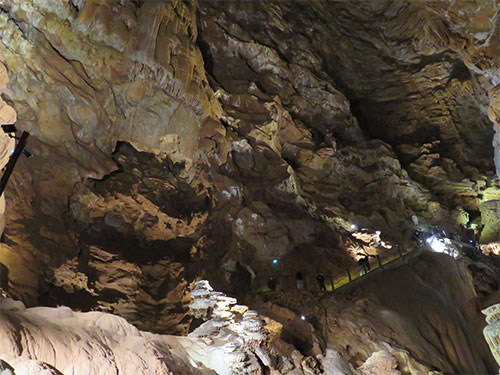
Since I had already visited the chasm before, seen the grand room, and knew that we would be taking a boat back, I decided to wait for Vere near the boat landing, while he scaled the long stairs up to take pictures of the grand room. When waiting, I decided to climb one short stair to read about the memorial of the cave’s discoveries, and it offered a place to sit. That was my mistake, as I had not remembered that the path was circular and came down the other side of the grand cave, taking people back to the boats.
When Vere traveled the path and descended via that circular path, I wasn’t there. He worried about where I had gone. He asked the attendants if they had seen me and they said no. He wanted to reverse his way back up and around the great room again, but the guards did not want him going against foot traffic. He said he had lost me, and was thinking about calling out the guards to come search for me. The poor guy was frantic, thinking I had fallen into the water or gotten lost, when all the time I had found a place to sit and wait, admiring the cave and thinking that Vere must be having a good long time taking pictures. But he insisted with the guards that he go back and search for me. He climbed all those stairs up and around the great room again, and that’s when he found me, not more than fifteen yards from where he had left me. I felt so bad that I had frightened him.
Until we returned to the surface, Vere would not take his eyes off of me. Together, we got back in the boat and returned to where we took the two elevators up and out. There was an outdoor café on the site, so we sat and had lunch. Vere tried the pork sausage, and I had an omelet with a salad.
Then if that cave experience had not been enough, we decided to go to another one in the commune of Lacave, called the Grottes de La Cave. The site consists of a group of limestone and dolomite caves formed in the Middle upper Jurassic period 145-174.7 million years ago. They were discovered accidentally on May 27, 1905, by the scientist and bio-speleologist Armond Viré, when he found prehistoric remains. Since he wanted to make the cave accessible to the public, he began to dig a tunnel from the road through solid rock. When he finally accomplished the task, the first visitors entered in September of 1906. Viré owned the cave until 1947.
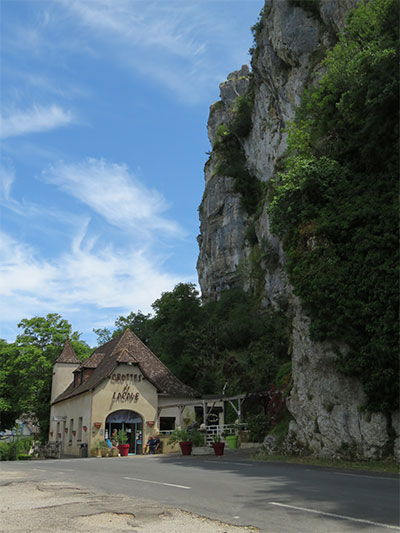
In order to reach the inner cave, people take an electric train, which began running in 1961. We got on and experienced a rickety and shaky ride that took us over 1300 feet into the mountain. The windows were covered, so we could not see the sides of the tunnel. Only a headlight at the front of the track allowed the driver to see where it was headed.
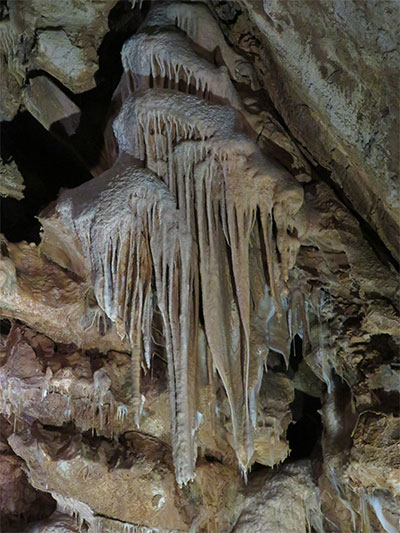
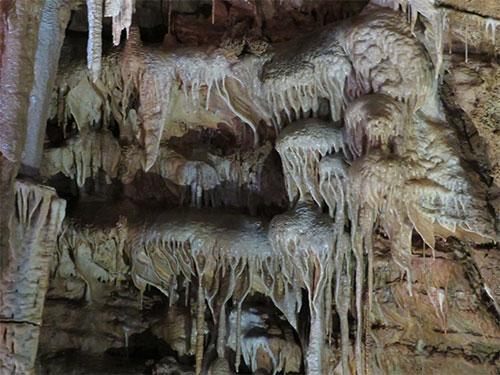
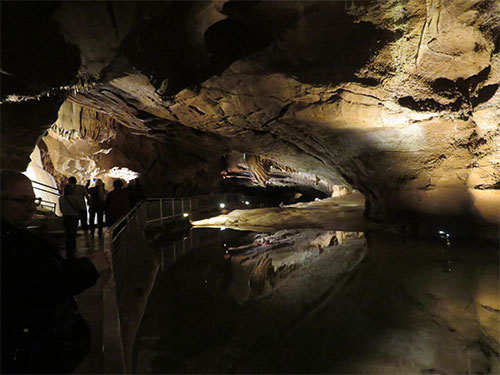
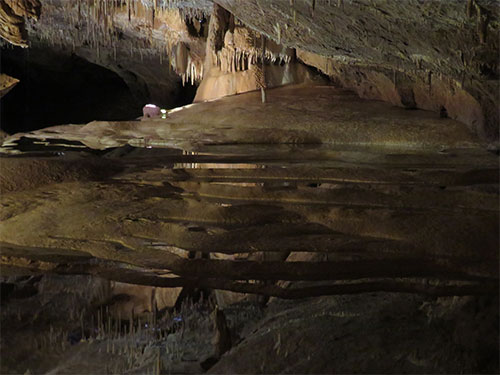
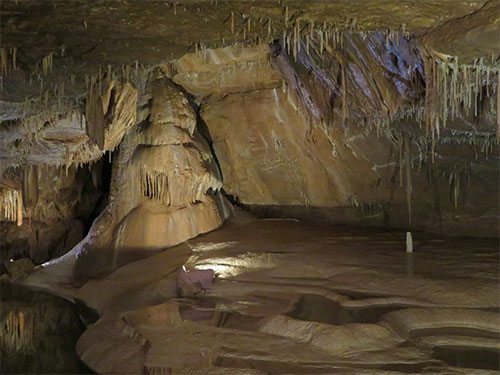
When the train stopped, we got out, and had a choice of either stairs or an elevator down four stories, to reach a trail where a guide would take us further. We were told we would see twelve different galleries, and each one had been named by the shapes of the concretions, although we only learned a few of the gallery names. There was the Hall of Tarasque, which had a formation resembling a dragon in a tortoise shell. The Hall of Chaos featured large limestone pillars. The Hall of Mirages had reflective lakes. The Hall of Wonders was the largest, reaching over 200 feet, and was known for its hundreds of stalactites that hang down and drip water. When these were lit with an ultraviolet light, they appeared as tiny raindrops falling in mid-air. The Black Light Hall illuminated certain rock formations. And there was the Three Fates Room.
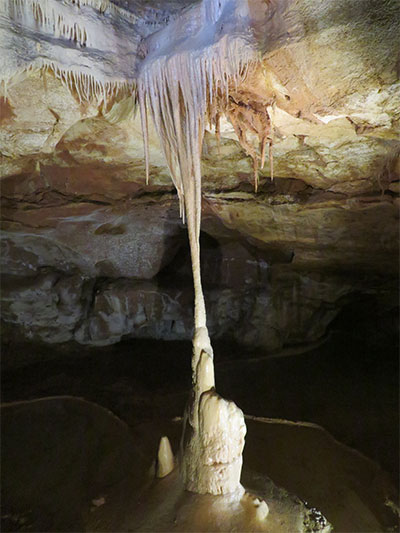
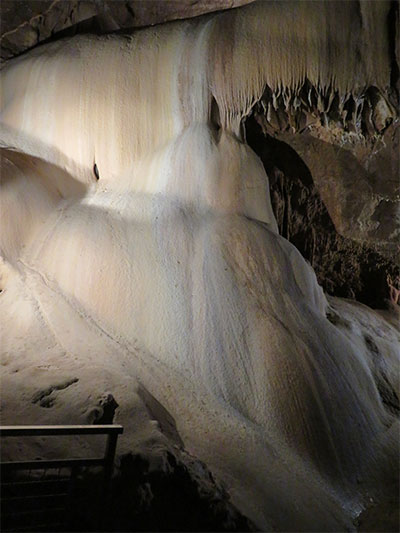
In the lake gallery, one lake was especially large, and the reflection made it look deep, but the water was quite shallow. At the other end, there were successive shelves of limestone where water spilled over onto the next. In another room, a stalagmite looked like a hand pointing upward in order to touch with an index finger, the descending stalactite. Also, a wide limestone formation, appeared as a frozen white waterfall, and a stalactite curtain sparkled like diamonds, dripping into the water. The temperature in the caves stayed constant, between 55-57º F.
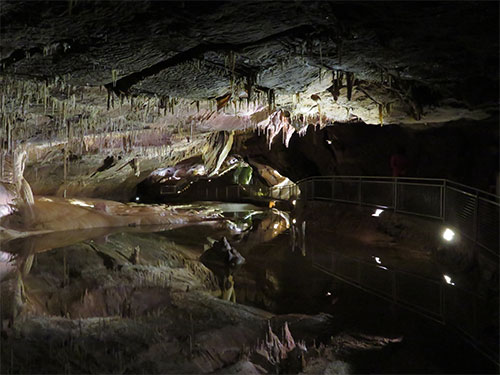
For nearly half of the cave experience, there were several children, who cried, ran about, and yelled their excitement, so much at times it was difficult for the guide to be heard. At one point, a small child began to go under a metal bar and enter into a lake. The mother grabbed him just in time, but dropped his jacket in the water. It was fished out quickly, but the child had to endure the cold for the rest of the walk. Fortunately, the adults with those children stayed behind us, so as not to interrupt the remainder of the tour.
When we exited the cave, it was very warm at 80ºF., so we crossed and got an ice cream. Vere had chocolate, and I had caramel. Then we left back to Sarlat, where Vere found a grocer open on Sunday (not easy to do), and we did a little shopping for our stay. We bought some food for a picnic, and a bottle of wine, as we had a fridge at the B&B to use.
We returned to the B&B, set up our laptops in the dining room and worked until 7:30. Then we refreshed ourselves in our room and went out for a dinner on the patio, offered that night to all twelve guests. We were given some sweet wine and an amuse-busche of a cheesy puff pastry. Vere had an appetizer of foie gras with the yellow rind of goose fat, on nut bread, and I had some gravlax with lime juice and pine nuts. Then Vere had canard confit, a leg and wing, with potatoes and carrots, and I had an Italian pasta dish with tuna and olives. For dessert, we were given a rendition of strawberry cheesecake. It had the traditional sweet graham base, and the filling was whipped cream, topped with spring strawberries and grated lime zest. The food and service were excellent.
That night, we were able to charge our hybrid car on the charger in the B&B parking lot.
 The official website of Lita-Luise Chappell, writer on sex, magic, food, distant lands, and everyday life with articles, poetry, novels, travelogues, rituals, cookbooks, and short-stories.